
200-301 · Question #1322
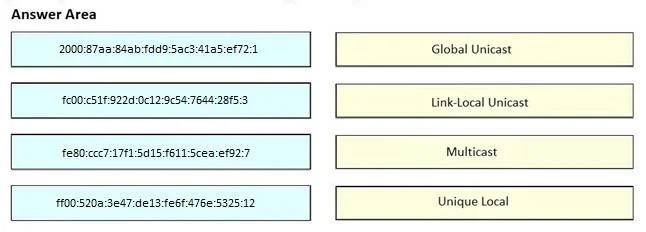
Drag and Drop Question Drag and drop the IPv6 address from the left onto the type on the right. Answer:
The correct answer is 2000:87aa:84ab:fdd9:5ac3:41a5:ef72:1 -> Global Unicast; fc00:c51f:922d:0c12:9c54:7644:28f5:3 -> Unique Local; fe80:ccc7:17f1:5d15:f611:5cea:ef92:7 -> Link Local Unicast; ff00:520a:3e47:de13:fe6f:476e:5325:12 -> Multicast. IPv6 Address Type Identification IPv6 address types are identified by their prefix bits - the first few characters tell you everything. --- 1. 2000:... -> Global Unicast Prefix: 2000::/3 (addresses starting with binary 001, i.e., 2000:: through 3FFF::) These are the IPv6…
Question
Exhibit
Answer Area
Drag items
Correct arrangement
- 2000:87aa:84ab:fdd9:5ac3:41a5:ef72:1 -> Global Unicast
- fc00:c51f:922d:0c12:9c54:7644:28f5:3 -> Unique Local
- fe80:ccc7:17f1:5d15:f611:5cea:ef92:7 -> Link Local Unicast
- ff00:520a:3e47:de13:fe6f:476e:5325:12 -> Multicast
Explanation
IPv6 Address Type Identification
IPv6 address types are identified by their prefix bits - the first few characters tell you everything.
1. 2000:... -> Global Unicast
Prefix: 2000::/3 (addresses starting with binary 001, i.e., 2000:: through 3FFF::)
- These are the IPv6 equivalent of public IPv4 addresses - routable on the global internet.
- Any address starting with
2or3falls in this range. - Common mistake: Confusing these with private addresses. In IPv6,
2000::/3is explicitly the globally routable space, assigned by IANA/RIRs.
2. fc00:... -> Unique Local
Prefix: fc00::/7 (addresses starting with FC or FD)
- Equivalent to IPv4 private ranges (10.x, 172.16.x, 192.168.x) - not routable on the internet.
FC00::/8is technically reserved;FD00::/8is the commonly used subrange.- Common mistake: Confusing Unique Local (
FC/FD) with Link-Local (FE80). Both are "private" but serve different scopes - Unique Local can span a site/organization; Link-Local is single-link only.
3. fe80:... -> Link-Local Unicast
Prefix: fe80::/10 (addresses starting with FE80 through FEBF)
- Automatically assigned to every IPv6-enabled interface; used for communication on the same network segment only.
- Never routed beyond the local link. Used for neighbor discovery (NDP), router discovery, etc.
- Common mistake: Thinking
fe80addresses need to be manually configured - they're auto-generated (often from the MAC address via EUI-64).
4. ff00:... -> Multicast
Prefix: ff00::/8 (all addresses starting with FF)
- Used to send traffic to multiple recipients simultaneously.
- Replaces IPv4 broadcast; there is no broadcast in IPv6 - multicast handles all those use cases.
- Common mistake: Confusing multicast (
FF) with anycast. Anycast addresses look identical to unicast - they're distinguished only by configuration, not by prefix.
Quick Reference Cheat Sheet
| Prefix | Type | Scope |
|---|---|---|
2000::/3 | Global Unicast | Internet-routable |
FC00::/7 | Unique Local | Site/org private |
FE80::/10 | Link-Local Unicast | Single link only |
FF00::/8 | Multicast | One-to-many |
The key skill is recognizing the first two hex characters of the address - that alone identifies the type in all four cases on this exam.
Topics
Community Discussion
No community discussion yet for this question.