nerdexam
IBM

000-221 · Question #96

A DLPAR memory operation was attempted and failed. Given the following information, what is the likely caused

The correct answer is C. Destination LPAR maximum memory setting is too low. A failed DLPAR memory move is most commonly caused by the destination LPAR having a maximum memory setting too low to accommodate the additional memory being added.

Troubleshooting and Problem Determination

Question

A DLPAR memory operation was attempted and failed. Given the following information, what is the likely caused

Exhibit
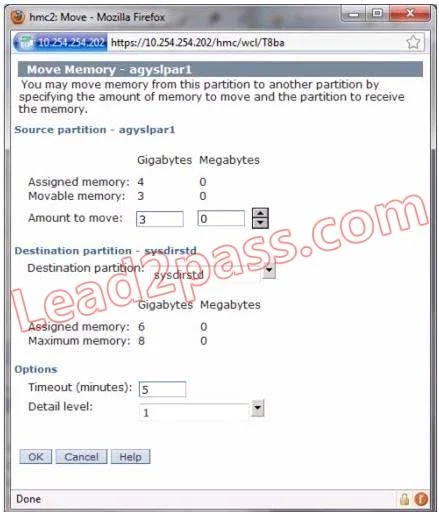
000-221 question #96 exhibit

Options

  • ASource LPAR is using all of its allocated memory
  • BOperation timed out
  • CDestination LPAR maximum memory setting is too low.
  • DHMC RMC daemons are not communicating properly to the source
  • ESource LPAR minimum memory setting is too high.
  • FSource LPAR maximum memory setting is too low.

How the community answered

(64 responses)
  • A
    2% (1)
  • B
    3% (2)
  • C
    83% (53)
  • D
    9% (6)
  • E
    2% (1)
  • F
    2% (1)

Why each option

A failed DLPAR memory move is most commonly caused by the destination LPAR having a maximum memory setting too low to accommodate the additional memory being added.

ASource LPAR is using all of its allocated memory

High memory utilization on the source LPAR affects performance but does not prevent the hypervisor from reallocating memory pages away from the source partition.

BOperation timed out

A timeout is a possible symptom of RMC or network issues but is not the likely root cause when a configuration boundary has been reached.

CDestination LPAR maximum memory setting is too low.Correct

In DLPAR operations, each partition has a maximum memory setting defined in its profile that acts as a hard ceiling; if the destination LPAR's current allocation plus the incoming memory block exceeds this maximum, the HMC will reject the operation before any memory is moved. This setting must be raised in the partition profile to allow the dynamic memory addition to succeed.

DHMC RMC daemons are not communicating properly to the source

RMC daemon communication failures would cause DLPAR commands to not reach the partition at all, resulting in a connectivity or timeout error rather than a memory boundary failure.

ESource LPAR minimum memory setting is too high.

The source LPAR minimum memory setting being too high would block removing memory below that floor, but this is a source-side constraint, not the cause described as most likely here.

FSource LPAR maximum memory setting is too low.

The source LPAR maximum memory setting limits how much memory can be added to the source, not removed from it; a low maximum on the source does not prevent outbound memory moves.

Concept tested: DLPAR memory operation - destination maximum memory limit

Source: https://www.ibm.com/docs/en/power-hmc/10.2?topic=partitions-managing-dynamic-logical-partitioning

Topics

#DLPAR#memory management#LPAR maximum memory#dynamic reconfiguration

Community Discussion

No community discussion yet for this question.

Full 000-221 Practice