
XK0-005 · Question #1794
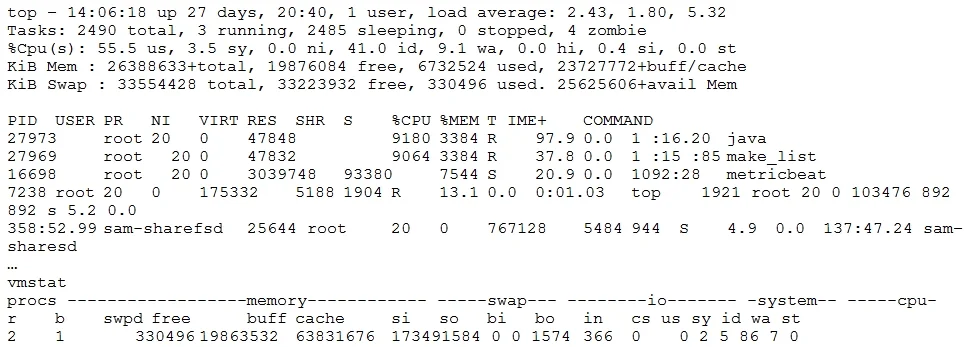
A Linux administrator is troubleshooting a system with low performance. The administrator runs a few commands and receives the following output: Which of the following is the most likely cause of…
The correct answer is D. The CPU utilization is high. High CPU utilization is the most likely cause of low performance if diagnostic output (not provided but implied) shows significant time spent in user, system, or I/O wait states.
Question
Exhibit
Options
- AThe disk I/O is high.
- BThe swap is low.
- CThe memory usage is high.
- DThe CPU utilization is high.
How the community answered
(30 responses)- A10% (3)
- B3% (1)
- C13% (4)
- D73% (22)
Why each option
High CPU utilization is the most likely cause of low performance if diagnostic output (not provided but implied) shows significant time spent in user, system, or I/O wait states.
While high disk I/O can cause low performance, it is often reflected as high I/O wait time in CPU statistics, making CPU utilization the more encompassing cause.
'Swap is low' is not a direct measure of performance; high swap *usage* can indicate low memory, but the phrase 'swap is low' is not indicative of an issue.
High memory usage by itself doesn't necessarily mean low performance unless it leads to excessive swapping or thrashing, which would then manifest in other metrics like high disk I/O or CPU wait time.
If the command output (which is implicitly showing CPU statistics from a tool like `top` or `vmstat`) indicates high percentages for user space (`us`), system space (`sy`), or I/O wait (`wa`) time, it means the CPU is heavily loaded or spending a lot of time waiting for I/O, which collectively points to high CPU utilization as the most likely cause of low system performance.
Concept tested: Linux performance troubleshooting, CPU utilization
Source: https://man7.org/linux/man-pages/man1/top.1.html
Topics
Community Discussion
No community discussion yet for this question.