
XK0-005 · Question #1795
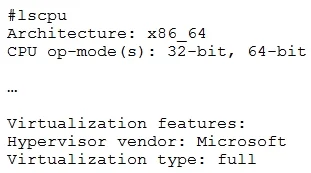
A Linux administrator is attempting to create a KVM on a remote Linux server. After failing to create the VM, the administrator runs some commands and reviews the following output: Output1: Output2…
The correct answer is B. The virtual server does not allow VMs running inside the VM. Failure to create a KVM virtual machine on a virtual server is most likely due to nested virtualization being disabled, preventing the VM from accessing required hardware virtualization extensions.
Question
Exhibit
Options
- AVirtualization does not work on 32-bit processors.
- BThe virtual server does not allow VMs running inside the VM.
- CThe memory capacity and swap space are both inadequate.
- DThe boot partition does not have enough available space.
How the community answered
(51 responses)- A6% (3)
- B71% (36)
- C8% (4)
- D16% (8)
Why each option
Failure to create a KVM virtual machine on a virtual server is most likely due to nested virtualization being disabled, preventing the VM from accessing required hardware virtualization extensions.
While 64-bit processors are common, the primary issue for KVM creation is the presence and activation of hardware virtualization extensions, not merely the processor's bitness.
KVM requires hardware virtualization extensions (Intel VT-x or AMD-V) to be available and enabled. If the server itself is a virtual machine and nested virtualization is not enabled on the underlying hypervisor, the KVM modules will fail to load or diagnostic tools will report that the required CPU virtualization features are unavailable, preventing the creation of new VMs inside it.
Inadequate memory or swap space might prevent a VM from starting or performing well, but it wouldn't typically prevent the *creation* of the VM if KVM itself isn't properly configured due to lack of CPU virtualization features.
Lack of space on the boot partition (`/boot`) typically impacts kernel updates or booting, not directly the creation of a KVM virtual machine's disk images, which are usually stored elsewhere.
Concept tested: KVM virtualization requirements, nested virtualization
Source: https://www.redhat.com/en/blog/virtualizing-virtualization-nested-kvm
Topics
Community Discussion
No community discussion yet for this question.