
PL-500 · Question #42
Drag and Drop Question You create a solution that uses a custom connector to call an external API. The API has a test and production instance. The connector must use the API instance related to the…
The correct answer is Create a custom connector.; Create environment variables to store the host URL and authentication details.; Set up the General tab by using environment variables.; Set up the Authentication by using environment variables.; Set the current values of the environment variables. This question assesses the understanding of how to parameterize an Azure custom connector using environment variables to support multiple deployment environments.
Question
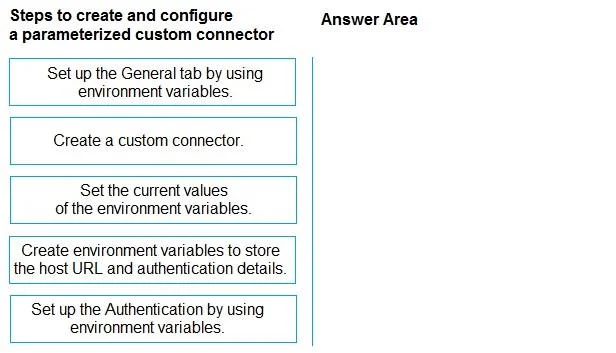
Drag and Drop Question You create a solution that uses a custom connector to call an external API. The API has a test and production instance. The connector must use the API instance related to the environment where it is deployed. You need to configure the custom connector, In which order should you perform the actions? To answer, move all actions from the list of actions to the answer area and arrange them in the correct order. NOTE: More than one order of answer choices is correct. You will receive credit for any of the correct orders you select. Answer:
Exhibit
Answer Area
Drag items
Correct arrangement
- Create a custom connector.
- Create environment variables to store the host URL and authentication details.
- Set up the General tab by using environment variables.
- Set up the Authentication by using environment variables.
- Set the current values of the environment variables.
Explanation
This question assesses the understanding of how to parameterize an Azure custom connector using environment variables to support multiple deployment environments.
Approach. The correct approach involves creating the custom connector first, then defining the necessary environment variables, configuring the connector's settings (General and Authentication) to reference these variables, and finally setting the environment-specific values for those variables.
Here's the detailed breakdown of the order shown in the second exhibit, which is one of the correct sequences:
- Create a custom connector: You must first create the basic structure of the custom connector before you can configure its details.
- Create environment variables to store the host URL and authentication details: Environment variables act as placeholders for environment-specific values. They must be defined before they can be referenced or used by other components, such as the custom connector.
- Set up the General tab by using environment variables: On the General tab of the custom connector (e.g., for the Host URL), you would configure it to use the environment variable created in the previous step. This requires the environment variable to already exist.
- Set up the Authentication by using environment variables: Similarly, if authentication details are environment-specific, you configure the custom connector's security/authentication settings to reference environment variables. This also requires the environment variables to already exist.
- Set the current values of the environment variables: This step assigns the actual, instance-specific values (e.g., the 'test' API host URL or the 'production' API host URL) to the environment variables. This is typically done during solution import into a target environment. It must happen after the variables are defined and the connector is configured to consume them.
The order of steps 3 and 4 ('Set up the General tab' and 'Set up the Authentication') can be swapped, as both depend on the environment variables existing and are part of configuring the custom connector's properties.
Common mistakes.
- common_mistake. A common mistake is attempting to configure the custom connector (General tab or Authentication) to use environment variables before those variables have been created. Another mistake is trying to 'Set the current values of the environment variables' before the variables themselves have been defined or before the custom connector has been configured to reference them. Setting current values prematurely or out of sequence would lead to errors or an improperly configured solution, as the components expecting those variables wouldn't be linked yet, or the variables wouldn't exist to have values assigned.
Concept tested. Parameterization of custom connectors in Power Platform/Dataverse using environment variables to manage environment-specific configurations (like API host URLs and authentication details) for seamless deployment across different environments (e.g., development, test, production).
Reference. null
Topics
Community Discussion
No community discussion yet for this question.