
PL-300 · Question #26
You build a report to analyze customer transactions from a database that contains the tables shown in the following table. You import the tables. Which relationship should you use to link the tables?
The correct answer is A. one-to-many from Customer to Transaction. In a standard retail/transactional database, one customer can have many transactions, but each transaction belongs to exactly one customer. This is a classic one-to-many relationship from the Customer table (the 'one' side) to the Transaction table (the 'many' side). A…
Question
You build a report to analyze customer transactions from a database that contains the tables shown in the following table. You import the tables. Which relationship should you use to link the tables?
Exhibit
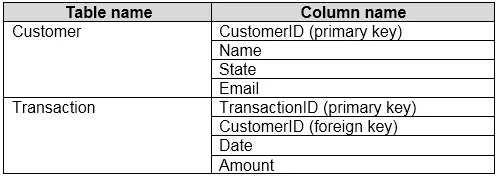
Options
- Aone-to-many from Customer to Transaction
- Bone-to-one between Customer and Transaction
- Cone-to-many from Transaction to Customer
- Dmany-to-many between Customer and Transaction
How the community answered
(37 responses)- A89% (33)
- B3% (1)
- C3% (1)
- D5% (2)
Explanation
In a standard retail/transactional database, one customer can have many transactions, but each transaction belongs to exactly one customer. This is a classic one-to-many relationship from the Customer table (the 'one' side) to the Transaction table (the 'many' side). A one-to-one relationship (B) would imply each customer has exactly one transaction, which is not realistic. A one-to-many from Transaction to Customer (C) reverses the cardinality incorrectly. A many-to-many (D) would only apply if customers could belong to multiple transactions in a non-foreign-key sense, which is not the case here.
Topics
Community Discussion
No community discussion yet for this question.