
PL-300 · Question #25
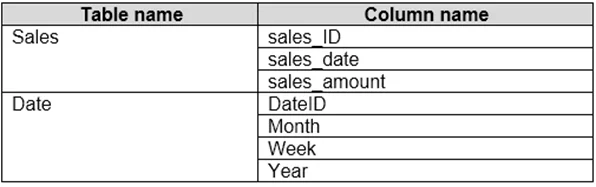
You have a sales system that contains the tables shown in the following table. The Date table is marked as a date table. DateID is the date data type. You need to create an annual sales growth…
The correct answer is C. (SUN(sales[sales_amount]) - CALCULATE(SUM(sales[sales_amount]). SAMEPERIODLASTYEAR returns a table that contains a column of dates shifted one year back in time from the dates in the specified dates column, in the current context. https://docs.microsoft.com/en-us/dax/sameperiodlastyear-function-dax
Question
You have a sales system that contains the tables shown in the following table. The Date table is marked as a date table. DateID is the date data type. You need to create an annual sales growth percentage measure. Which DAX expression should you use?
Exhibit
Options
- ASUM(sales[sales_amount]) - CALCULATE(SUM(sales[sales_amount]),
- BCALCULATE(SUM(sales[sales_amount]), DATESYTD('Date'[DatelD]))
- C(SUN(sales[sales_amount]) - CALCULATE(SUM(sales[sales_amount]),
- DCALCULATE(SUH(sales[sales_amount]), SAMEPERIODLASTYEAR('Date'[DatelD])
How the community answered
(22 responses)- A9% (2)
- B5% (1)
- C73% (16)
- D14% (3)
Explanation
SAMEPERIODLASTYEAR returns a table that contains a column of dates shifted one year back in time from the dates in the specified dates column, in the current context. https://docs.microsoft.com/en-us/dax/sameperiodlastyear-function-dax
Topics
Community Discussion
No community discussion yet for this question.