nerdexam
MicrosoftMicrosoft

PL-200 · Question #169

PL-200 Question #169: Real Exam Question with Answer & Explanation

The question assesses the ability to distinguish between Dataverse search, Quick find, and Advanced find functionalities to match specific search requirements in a Microsoft Dataverse model-driven app.

Create apps by using Microsoft Power Apps

Question

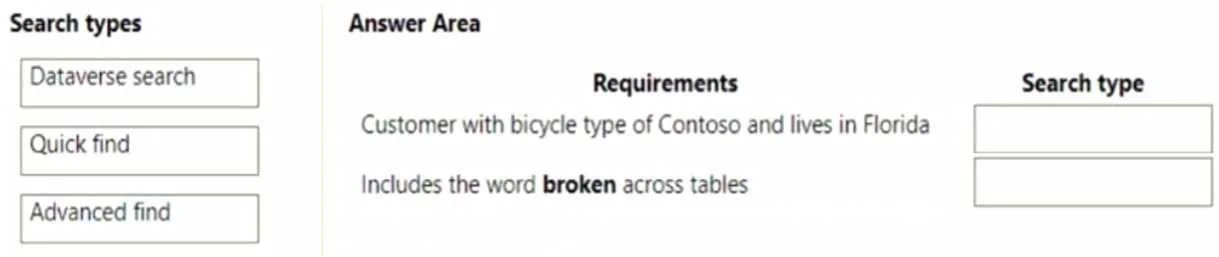
Drag and Drop Question You modify a model-driven app for a bicycle repair help desk. The model-driven app is for help desk users when customers have an issue with their bicycle. After you add a custom table named bicycle, you configure the table for Microsoft Dataverse search. The table will contain information from callers about their bicycles. The account table is related to the custom table. Contact information is brought over to the custom table. You add the following columns to the table: - Bicycle type - Tire brand - Special equipment Users must be able to perform the following types of searches: - Search for all customers who have a bicycle type of Contoso and live in Florida. - Search all tables for any record that contains the word broken. You need to decide which type of search will give you the results desired. Which search should you configure? To answer, drag the appropriate search types to the correct requirements. Each search type may be used once, more than once, or not at all. You may need to drag the split bar between panes or scroll to view content. NOTE: Each correct selection is worth one point. Answer:

Explanation

The question assesses the ability to distinguish between Dataverse search, Quick find, and Advanced find functionalities to match specific search requirements in a Microsoft Dataverse model-driven app.

Approach. 1. For the requirement 'Customer with bicycle type of Contoso and lives in Florida', the correct choice is 'Advanced find'. This requirement demands a complex query involving multiple specific criteria ('bicycle type of Contoso' AND 'lives in Florida') and likely requires searching across related tables (the custom 'bicycle' table and the 'account' or 'contact' table for location information). Advanced find is specifically designed to allow users to build highly granular, multi-condition queries, filter data across related entities, and save these queries for future use. 2. For the requirement 'Includes the word broken across tables', the correct choice is 'Dataverse search'. This requirement calls for a broad, full-text keyword search across all relevant tables in the system. Dataverse search (formerly Relevance Search) excels at this, providing fast, comprehensive, and relevant results by indexing data across multiple tables and fields, making it ideal for finding a specific word or phrase anywhere in the data.

Common mistakes.

  • common_mistake. A common mistake would be to use 'Quick find' for either requirement. Quick find is limited to searching within a single table based on the fields configured in that table's Quick Find view, making it unsuitable for multi-criteria searches across related tables or system-wide keyword searches. Another mistake would be to swap 'Dataverse search' and 'Advanced find'. While Dataverse search might find some records related to 'Contoso Florida', it's not designed for the precise conditional filtering of 'bicycle type EQUALS Contoso AND city EQUALS Florida'. Conversely, while Advanced find could technically search for 'broken' across many specific fields, Dataverse search is the more efficient and intended tool for a general, comprehensive keyword search spanning multiple tables without needing to specify each field individually.

Concept tested. The core concept tested is the understanding of different search functionalities within Microsoft Dataverse (Power Apps model-driven apps and Dynamics 365), specifically the capabilities and appropriate use cases for Advanced Find, Dataverse Search (Relevance Search), and Quick Find.

Topics

#Model-driven apps search#Dataverse search#Advanced Find#User experience

Community Discussion

No community discussion yet for this question.

Full PL-200 PracticeBrowse All PL-200 Questions