
PL-200 · Question #149
Drag and Drop Question A company has a portal. Users sign into the portal by using a social media account. The company wants to replace the existing portal with a Power Apps portal. Users must sign…
The correct answer is Yes; No. The correct configuration enables external sign-in to allow Microsoft account authentication while disabling open registration to enforce the use of invitation codes for portal access.
Question
Exhibit
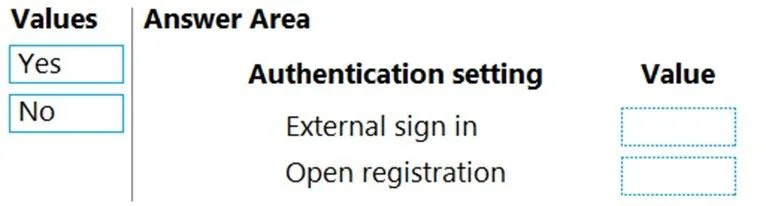
Answer Area
Drag items
Correct arrangement
- Yes
- No
Explanation
The correct configuration enables external sign-in to allow Microsoft account authentication while disabling open registration to enforce the use of invitation codes for portal access.
Approach. 1. External sign in - Yes: The scenario states, 'Users must sign up for access to the portal by using a Microsoft account'. A Microsoft account is an external identity provider. To allow users to authenticate using their Microsoft accounts, 'External sign in' must be enabled. Therefore, 'Yes' should be dragged to 'External sign in'. 2. Open registration - No: The scenario specifies that users 'must sign up for access to the portal by using a Microsoft account and a unique invitation code that will be provided to the users'. This means self-registration without an invitation code should not be allowed. 'Open registration' would permit users to sign up without any such code. To enforce the use of invitation codes, 'Open registration' must be disabled. Therefore, 'No' should be dragged to 'Open registration'.
Common mistakes.
- common_mistake. 1. External sign in - No: If 'External sign in' were set to 'No', users would be unable to authenticate using a Microsoft account, directly contradicting the requirement for users to sign up with a Microsoft account.
- Open registration - Yes: If 'Open registration' were set to 'Yes', users could register for the portal without needing a unique invitation code. This would bypass the security requirement to use an invitation code and violate the problem statement.
- Incorrect pairing or reversal: Swapping the values (e.g., 'No' for External sign in and 'Yes' for Open registration) would result in a configuration that prevents required Microsoft account authentication and enables forbidden open registration, completely failing to meet the scenario's requirements.
Concept tested. Power Apps portal authentication configuration, specifically understanding how to manage external identity providers (like Microsoft accounts) and control user registration methods (open vs. invitation-based) within Power Apps portals.
Topics
Community Discussion
No community discussion yet for this question.