
NSE4 · Question #440
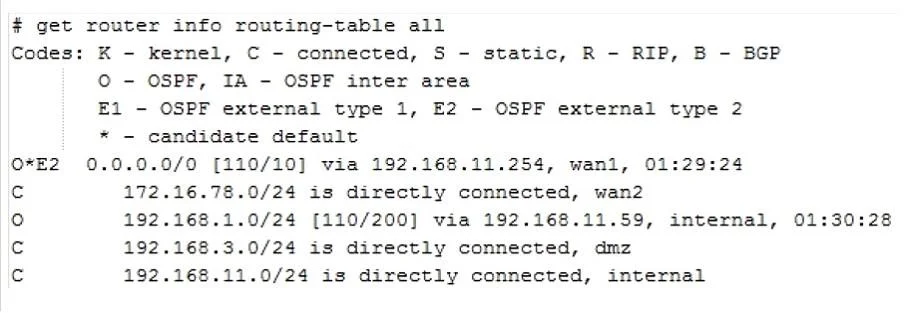
The exhibit shows a FortiGate routing table. Which of the following statements are correct?(Choose two)
The correct answer is A. There is only one active default route. D. The FortiGate will route the traffic to 172.17.1.2 to next hop with the IP address. Based on a typical FortiGate routing table (not provided), there is usually only one active default route, and traffic is routed to its next hop based on the most specific matching entry.
Question
The exhibit shows a FortiGate routing table. Which of the following statements are correct?(Choose two)
Exhibit
Options
- AThere is only one active default route.
- BThe distance values for the route to 192.168.1.0/24 is 200
- CAn IP address in the subnet 172.16.78.0/24 has been assigned to the dmz interface.
- DThe FortiGate will route the traffic to 172.17.1.2 to next hop with the IP address
How the community answered
(16 responses)- A69% (11)
- B19% (3)
- C13% (2)
Why each option
Based on a typical FortiGate routing table (not provided), there is usually only one active default route, and traffic is routed to its next hop based on the most specific matching entry.
A routing table, even if configured with multiple default routes, will typically have only one active default route (0.0.0.0/0) at any given time, determined by administrative distance and metric.
Without the exhibit, the specific distance value for the route to 192.168.1.0/24 cannot be confirmed, and '200' is not a universally default administrative distance for this type of route.
Without the exhibit's depiction of interface configurations, it is impossible to verify whether an IP address within the 172.16.78.0/24 subnet has been assigned to the dmz interface.
The FortiGate will route traffic to any IP address, such as 172.17.1.2, to the specific next-hop IP address defined by the most specific matching route in its routing table.
Concept tested: FortiGate routing table interpretation
Source: https://docs.fortinet.com/document/fortigate/7.4.0/administration-guide/867295/routing
Topics
Community Discussion
No community discussion yet for this question.