
NSE4 · Question #423
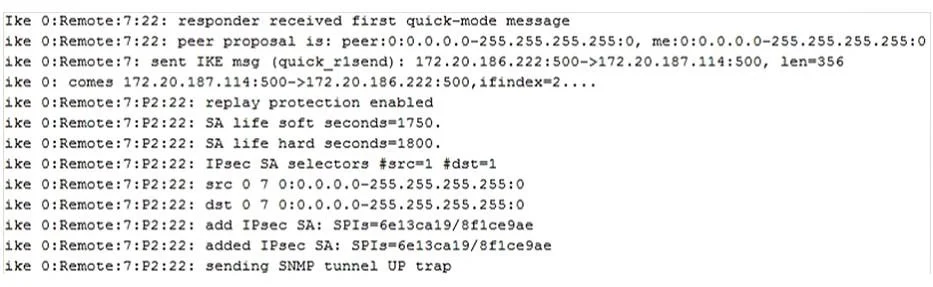
The exhibit shows a part output of the diagnostic command 'diagnose debug application ike 255', taken during establishment of a VPN. Which of the following statement are correct concerning this…
The correct answer is B. The output corresponds to a phase 2 negotiation D. The IP address of the remote IPsec VPN peer is 172.20.187.114. The diagnostic output from 'diagnose debug application ike 255' reveals details about the IPSec Phase 2 negotiation and identifies the remote peer's IP address.
Question
The exhibit shows a part output of the diagnostic command 'diagnose debug application ike 255', taken during establishment of a VPN. Which of the following statement are correct concerning this output? (choose two)
Exhibit
Options
- AThe quick mode selectors negotiated between both IPsec VPN peers is 0.0.0.0/32 for both
- BThe output corresponds to a phase 2 negotiation
- CNAT-T enabled and there is third device in the path performing NAT of the traffic between both
- DThe IP address of the remote IPsec VPN peer is 172.20.187.114
How the community answered
(40 responses)- A5% (2)
- B80% (32)
- C15% (6)
Why each option
The diagnostic output from 'diagnose debug application ike 255' reveals details about the IPSec Phase 2 negotiation and identifies the remote peer's IP address.
Quick mode selectors like 0.0.0.0/32 for both ends would imply specific host-to-host tunnels and are not always the negotiated selectors; the actual selectors would need to be visible in the exhibit.
Messages such as 'quick mode' or 'Phase 2' in the IKE debug output directly indicate that the negotiation for data encryption SAs (Security Associations) is occurring, which is characteristic of IPSec Phase 2.
Determining if NAT-T is enabled and if a third device is performing NAT requires specific NAT-T negotiation messages and address translation details in the debug output, which is not stated to be present.
The debug output for IKE negotiations explicitly logs the IP addresses of both the local and remote VPN peers involved in the communication, making the remote peer's IP address (172.20.187.114) identifiable.
Concept tested: FortiGate IPSec IKE Debug Output Analysis
Source: https://docs.fortinet.com/document/fortigate/7.4.0/administration-guide/603403/troubleshooting-ipsec-vpns
Topics
Community Discussion
No community discussion yet for this question.