
MS-720 · Question #82
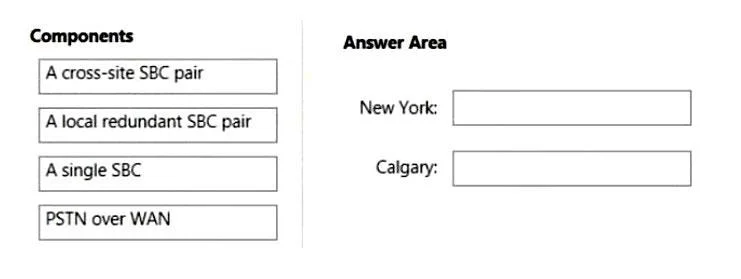
Drag and Drop Question Your company has a main office in New York and a branch office in Calgary. All offices connect to each other by using a dedicated WAN. You have a Microsoft Teams Phone…
The correct answer is A local redundant SBC pair; A cross-site SBC pair. The question requires selecting appropriate Session Border Controller (SBC) configurations for two offices to ensure PSTN service availability and minimize SBCs, leveraging local redundancy for the main office and cross-site failover for the branch office.
Question
Exhibit
Answer Area
Drag items
Correct arrangement
- A local redundant SBC pair
- A cross-site SBC pair
Explanation
The question requires selecting appropriate Session Border Controller (SBC) configurations for two offices to ensure PSTN service availability and minimize SBCs, leveraging local redundancy for the main office and cross-site failover for the branch office.
Approach. For New York, the requirement is: 'If a Session Border Controller (SBC) fails in the New York office, PSTN services must remain available through a local PSTN egress in New York.' This explicitly demands local redundancy for PSTN services. Therefore, 'A local redundant SBC pair' is the correct component for New York, as it ensures continuous local PSTN access even if one SBC fails.
For Calgary, the requirements are: 'The Calgary office must prioritize a local PSTN egress and ensure that PSTN services remain available in the event of a local SBC outage. - The number of SBCs must be minimized.' To prioritize local PSTN egress, Calgary needs at least one local SBC. To ensure availability during an outage while minimizing SBCs, a cost-effective solution is to deploy a single local SBC for primary egress and use the existing redundant SBCs in New York as a failover mechanism. In this scenario, 'A cross-site SBC pair' describes the redundancy strategy for Calgary, meaning its PSTN services will fail over to the SBCs located at the New York site if its local SBC becomes unavailable. This approach meets all requirements: local priority (via the single local SBC), availability during outage (via cross-site failover), and minimized SBC count (single local SBC in Calgary, plus the pair in New York).
Common mistakes.
- common_mistake. Dragging 'A single SBC' to Calgary is incorrect because while it would prioritize local PSTN egress, it would not ensure PSTN services remain available in the event of a local SBC outage, failing the redundancy requirement. Dragging 'A local redundant SBC pair' to Calgary would satisfy local egress and availability but would violate the 'number of SBCs must be minimized' requirement, as it would add two SBCs to Calgary instead of one local SBC with cross-site failover, leading to a higher total SBC count. 'PSTN over WAN' is a description of how calls might traverse the network, not a component or a specific redundancy solution for an office's SBC setup, making it an inappropriate choice for either location.
Concept tested. The core concept tested is the design and implementation of Microsoft Teams Direct Routing solutions, specifically focusing on Session Border Controller (SBC) deployment strategies for redundancy, high availability, and disaster recovery across multiple sites. It assesses understanding of local redundancy, cross-site failover mechanisms, and optimizing infrastructure (minimizing SBCs) in a multi-site Direct Routing environment.
Topics
Community Discussion
No community discussion yet for this question.