
MS-720 · Question #83
Drag and Drop Question You have a Microsoft Teams Phone deployment. You need to configure voice routing for Direct Routing. The solution must only allow calling within the United States and Canada…
The correct answer is Add a PSTN usage record named Record1.; Create a voice route that has a dialed number pattern of "^\\+1(425)(\\d{7})$"; Create a voice routing policy.; Assign a voice routing policy to user1. Microsoft Teams Direct Routing - Voice Routing Configuration The Core Concept: Dependency Chain Direct Routing voice routing follows a strict dependency chain. Each object must exist before the next one can reference it: `` PSTN Usage Record ← Voice Route (references it) PSTN…
Question
Exhibit
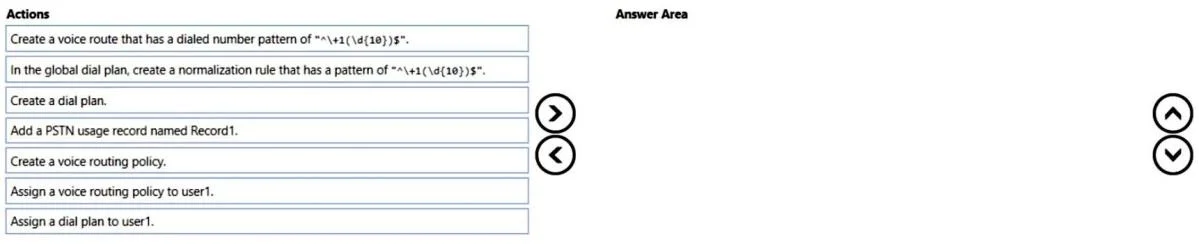
Answer Area
Drag items
Correct arrangement
- Add a PSTN usage record named Record1.
- Create a voice route that has a dialed number pattern of "^\+1(425)(\d{7})$"
- Create a voice routing policy.
- Assign a voice routing policy to user1.
Explanation
Microsoft Teams Direct Routing - Voice Routing Configuration
The Core Concept: Dependency Chain
Direct Routing voice routing follows a strict dependency chain. Each object must exist before the next one can reference it:
PSTN Usage Record ← Voice Route (references it)
PSTN Usage Record ← Voice Routing Policy (contains it)
Voice Routing Policy → assigned to → User
Why Each Step Is in This Order
Step 1 - Add a PSTN usage record named Record1
PSTN usage records are the linchpin of the entire chain. Both voice routes and voice routing policies reference PSTN usage records - so Record1 must exist before you can attach it to either. It has no dependencies of its own, making it the correct starting point.
Step 2 - Create a voice route with pattern ^\+1(425)(\d{7})$
A voice route must reference an existing PSTN usage record (Record1) to be valid. The regex ^\+1(425)(\d{7})$ matches E.164-formatted US numbers (+1 country code, 425 area code, 7 remaining digits). This route defines which numbers are routable and through which SBC - but it only becomes reachable to users via the PSTN usage record link.
Step 3 - Create a voice routing policy
A voice routing policy is a container that holds one or more PSTN usage records (which in turn point to voice routes). You can't build this policy until Record1 exists. The policy controls what calling is permitted - without it, there's no way to enforce the US/Canada restriction for user1.
Step 4 - Assign the voice routing policy to user1
This is the final wire-up. Assigning the policy to user1 activates all the routing logic specifically for that account. You must assign after the policy is fully configured - assigning a partially built policy could leave the user with broken or unrestricted routing.
Why the Other Two Items Are Excluded
"In the general dial plan, create a normalization rule with pattern ^\+1(\d{10})$"
The general (global) dial plan applies to all users in the tenant, not just user1. Modifying it risks disrupting existing users' call behavior - directly contradicting the requirement to minimize user call disruption. Dial plan normalization also controls number format translation (to E.164), not call routing restrictions, which is the actual goal here.
"Assign a dial plan to user1"
Dial plans govern how dialed numbers are normalized (e.g., converting 4255551234 to +14255551234). They do not control routing permissions or PSTN access. For restricting which calls a user can make, the voice routing policy is the correct lever. Assigning a dial plan here would be solving the wrong problem.
Common Misconceptions
| Misconception | Reality |
|---|---|
| "Create the voice routing policy first since it's the user-facing object" | The policy depends on PSTN usage records, so records must come first |
| "The normalization rule is needed to handle +1 formatting" | Numbers dialed in Direct Routing are expected to already be E.164; the normalization rule is a distractor that also modifies global scope |
| "Configure vs. Assign a voice routing policy are different steps" | In the exam context they refer to the same final action - attaching the completed policy to user1 |
| "The 425 pattern is wrong because it doesn't cover all of US/Canada" | The pattern matches valid US E.164 numbers; for a real deployment you'd use ^\+1(\d{10})$, but the exam is testing ordering logic, not pattern design |
Topics
Community Discussion
No community discussion yet for this question.