Case Study 1 - Wide World Importers Background Wide World Importers sell office supplies, furniture, and fittings to their customers across the United States. The company has the following…
The correct answer is package; new model; project; deployable package. Deploying the Web Portal Integration Solution - Explained Context (Critical Starting Point) The requirements state: "The solution is supplied as a source code model file." This distinguishes it from the credit card processing solution, which arrives as a ready-made deployable…
Perform testing, performance monitoring, and ALM
Question
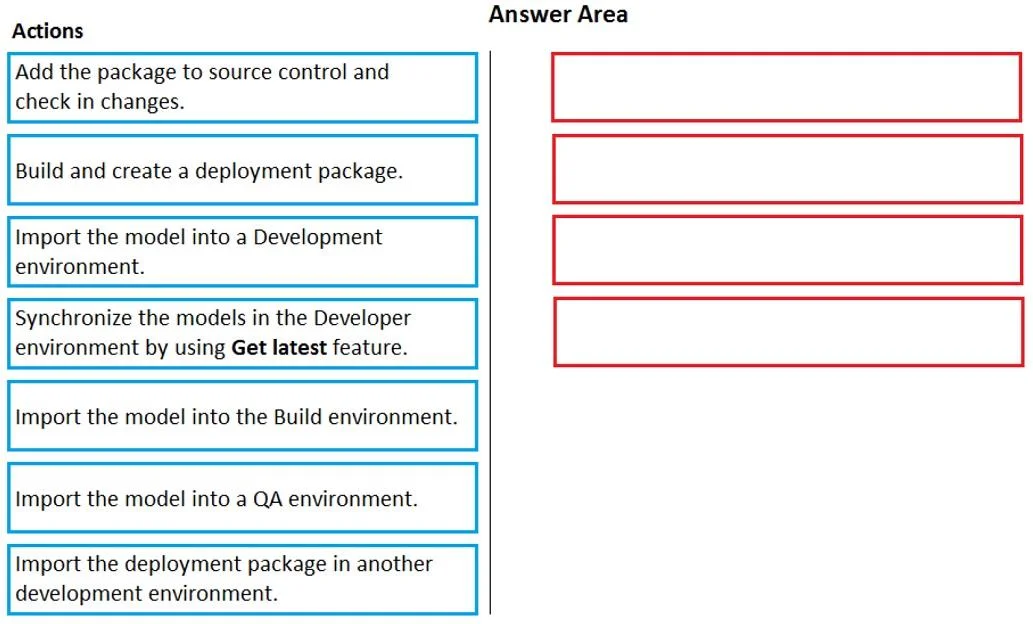
Case Study 1 - Wide World Importers Background Wide World Importers sell office supplies, furniture, and fittings to their customers across the United States. The company has the following locations: a retail store in Seattle a warehouse in Seattle a customer support and call center in Atlanta a team of field workers that provide furniture installation services at customer sites. Wide World Importers plans to implement Dynamics 365 Finance and Microsoft Azure cloud platform features. Current environment Customers may place orders by email, phone, or by using the company's website. The company authorizes and processes credit card transactions by using a web-based application. Customer, inventory, supplier, and other master and transactional data is stored in a legacy database. The company collects feedback from customers by phone or a form on the company's website and maintains the data in a Microsoft Excel workbook. Wide World Importers runs on-premises applications to manage payroll and workers compensation. The company has a set of Microsoft Power BI dashboards that present data from a reporting database. The company creates a Lifecycle Services (LCS) implementation project and completes Dynamics 365 Finance onboarding. The company maintains production, quality assurance (QA), development, user acceptance testing (UAT), and build environments. Requirements General You must configure a cloud-based Dynamics 365 Finance development environment and enable code extension that support updates. You must configure version control and a Build environment. You must migrate all legacy data to the new system. You must implement best practices for X++ coding, the data model, caching, and security. All new code must be unit tested in a development environment and then validated by the QA team before code is added to source control. Business processes You must configure vendor trade agreements. Products must be shipped directly from suppliers to customers depending on customer location to save indirect costs. You must collect customer feedback on products shipped directly from vendors. You must deploy code to a UAT environment for testing before deploying code to production. You must validate all entries for the purchase order creation form. You must develop a web portal that allows customers to browse products, place orders, and check order status. Product data for the web portal must be integrated as periodic batches. Business systems You must install and configure a third-party solution for credit card processing within Dynamics 365 Finance. The third-party company will provide a deployable package. The workers compensation application must be able to call an API to update worker compensation details in Dynamics 365 Finance. You must develop a process to import payroll journals into the system. You must configure the warehouse mobile device portal for warehouse operations. You must install a third-party solution to support web portal integration. The solution is supplied as a source code model file. Vendor exclusion list You must develop a new solution to maintain a Vendor exclusion list for each customer and item combination. The solution must meet the following requirements: Isolate all new vendor exclusion codes as a new assembly by creating a table named VendExclusions. Create an index for the table named PrimaryIdx that uses the following fields: CustAccount, ItemId, VendAccount. Ensure that users can open the Vendor Exclusion list report from the customer master form. The list must display the customer account, Item ID, and Vendor account fields. Implement the Excel integration for the Vendor Exclusion List form. Provide functionality to periodically export the Vendor exclusion list to prepare reports by using standard reporting capabilities of Dynamics 365 Unified Operations. Develop necessary security permissions to view and maintain the new Vendor exclusion list functionality and reporting. Users with maintain rights will be able create, update, and delete the exclusion list. Permissions must be assigned to security roles to match company security model. Maintain referential integrity with other tables. Users must be presented with a warning message before a direct delivery purchase order is created for a vendor in exclusion list. Sales managers must be alerted when a new exclusion record is added to the system. Security You must implement the record level audit feature to identify the users who created the record. Grant specific users rights to maintain the vendor exclusion list by using Excel. You must implement validation to check whether a proposed direct delivery purchase order vendor is on the exclusion list for the customer and product combination. Issues User1 is not able to access many features in the system. You must provide User1 administrator rights. A sales manager suspects a data-related issue in the vendor exclusion list. User1 must identify the user who created the referenced exclusion records. Developer2 joins the company and does not have access to a development environment or source control. User2 reports performance issues when they generate direct delivery purchase orders after current updates are applied. User2 reports that they cannot access new functionality and reports. Drag and Drop Question You need to deploy the web portal integration solution. Which four actions should you perform in sequence? To answer, move the appropriate actions from the list of actions to the answer area and arrange them in the correct order. Answer:
Deploying the Web Portal Integration Solution - Explained
Context (Critical Starting Point)
The requirements state: "The solution is supplied as a source code model file." This distinguishes it from the credit card processing solution, which arrives as a ready-made deployable package. A source code model file must go through the full D365FO development pipeline before it can be deployed.
The Correct Sequence
1. package
Why first: In Dynamics 365 F&O, every model must live inside a package (a compilation/deployment unit stored in PackagesLocalDirectory). Before you can register a new model, you must have a target package to place it in. This is the foundational container.
Think of a package as a folder/namespace that groups related models and compiles together as a unit.
2. new model
Why second: Once the package exists, you import the source code model file as a new model inside that package. It's "new" because this is third-party code being introduced - it does not belong to any existing model. This registers the model metadata and source files in the environment.
This is the step where the .axmodel file is consumed (via ModelUtil.exe -import or similar tooling).
3. project
Why third: With the model registered, you create a Visual Studio project linked to that model. The project allows you to compile the source code, reference the model's elements, and trigger a build. You cannot build what you haven't set up as a project.
4. deployable package
Why last: After building the project successfully, you create a deployable package - a self-contained artifact that LCS can apply to UAT and production environments. This is the output of the build pipeline and the mechanism for promoting code across environments.
Why the Unused Items Don't Fit
Item
Why excluded
model file
This is the input artifact you receive - not an action step. You use it in step 2, but it isn't itself a sequential action.
existing model
You're introducing brand-new third-party source code. Adding it to an existing model would violate isolation best practices and risk breaking existing functionality.
Common Mistakes
Choosing model file as a step: Candidates confuse having the model file with it being a deployment action. The file is the thing you receive; "new model" is what you do with it.
Choosing existing model: The requirement to isolate new code (reinforced throughout the case study, e.g., the VendExclusions assembly) makes new model the correct choice.
Skipping package: Many assume you go straight to creating a model, but in D365FO a model cannot exist without a parent package.
Confusing this with the credit card scenario: The credit card third-party solution arrives as a deployable package and is applied directly - no build pipeline needed. The web portal solution requires the full source code path: package → new model → project → deployable package.