
MB-500 · Question #340
Drag and Drop Question A company uses Dynamics 365 finance and operations apps. The company must ensure employees use best practices when performing data validation and functional, regression, and…
The correct answer is Regression suite automation tool (RSAT); task recorder; Acceptance test library (ATL); SysTest framework. Dynamics 365 F&O Testing Frameworks - Question Explained The question presents 4 scenarios (unlabeled in your excerpt, but standard in the exam) and asks you to match each to the correct tool. Here's what those scenarios typically are and why each answer is correct. --- The…
Question
Exhibit
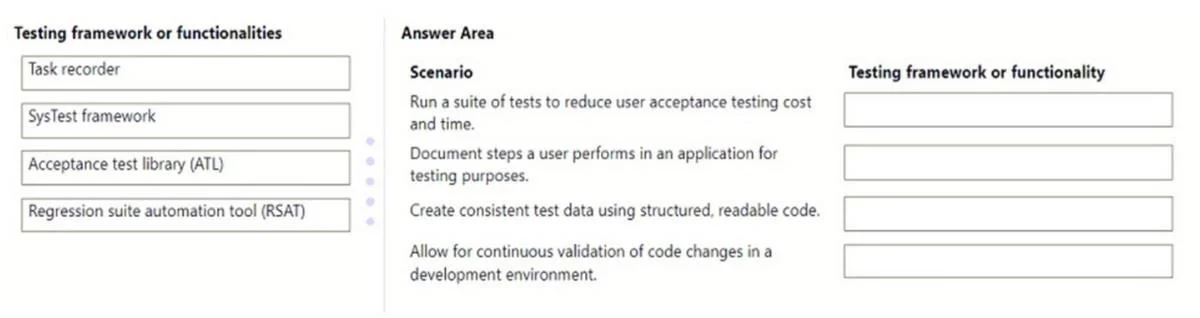
Answer Area
Drag items
Correct arrangement
- Regression suite automation tool (RSAT)
- task recorder
- Acceptance test library (ATL)
- SysTest framework
Explanation
Dynamics 365 F&O Testing Frameworks - Question Explained
The question presents 4 scenarios (unlabeled in your excerpt, but standard in the exam) and asks you to match each to the correct tool. Here's what those scenarios typically are and why each answer is correct.
The Scenarios and Answers
Scenario 1 → Regression Suite Automation Tool (RSAT)
Scenario: Automate regression and user acceptance testing of business processes.
RSAT is designed for end-to-end automated regression testing. It reads test cases recorded via Task Recorder, stored in Azure DevOps, and replays them against F&O without manual intervention. It's the go-to tool when a company wants to verify that system updates haven't broken existing workflows.
Scenario 2 → Task Recorder
Scenario: Capture and document business process steps to create test cases.
Task Recorder is a built-in F&O tool that records every user action (clicks, field inputs, menu navigation) as a structured document or test script. It is the prerequisite step before using RSAT - you record first, then automate. It also generates training documentation (Word/BPM).
Scenario 3 → Acceptance Test Library (ATL)
Scenario: Write structured X++ code to perform functional or acceptance testing with reusable test data.
ATL is an X++ framework that provides a higher-level abstraction for writing test code. It uses a Given/When/Then pattern and offers pre-built helpers to create test data and assert outcomes. It's appropriate for functional testing where developers want maintainable, readable test code - not just raw unit tests.
Scenario 4 → SysTest Framework
Scenario: Write low-level X++ unit tests for individual classes or methods.
SysTest is the foundational X++ unit testing framework (analogous to JUnit/xUnit). It tests individual code components in isolation. Developers extend SysTestCase to write test classes. It's the right choice when testing a single method or class, not an end-to-end business process.
Hierarchy Summary
Task Recorder       → Records steps (input for RSAT)
RSAT                → Automates regression/UAT using those recordings
ATL                 → Structured X++ functional/acceptance test code
SysTest Framework   → Low-level X++ unit tests
Common Mistakes
| Mistake | Why it's wrong |
|---|---|
| Using RSAT for unit testing | RSAT is process-level, not code-level |
| Confusing ATL with SysTest | ATL wraps SysTest with higher-level helpers; SysTest is the raw framework |
| Thinking Task Recorder runs tests | It only records - it doesn't execute automated tests |
| Using SysTest for regression testing | SysTest has no UI automation; RSAT handles that |
The key mental model: Task Recorder feeds RSAT (UI automation), while ATL builds on SysTest (code-level testing). They are two separate tracks - one for business users/testers, one for developers.
Topics
Community Discussion
No community discussion yet for this question.