
MB-500 · Question #306
Case study 4 - ADatum Corporation Background ADatum Corporation is a market leader in the design and distribution of innovative aluminum systems. The company provides services to the architectural…
The correct answer is No; Yes; Yes. Data Entity Properties for Purchase Order Inquiries Context from Requirements The key requirement driving all three property values: > "Purchase order inquiries must be exported using data packages. Users must be able to query using OData but should not be able to update or…
Question
Exhibit
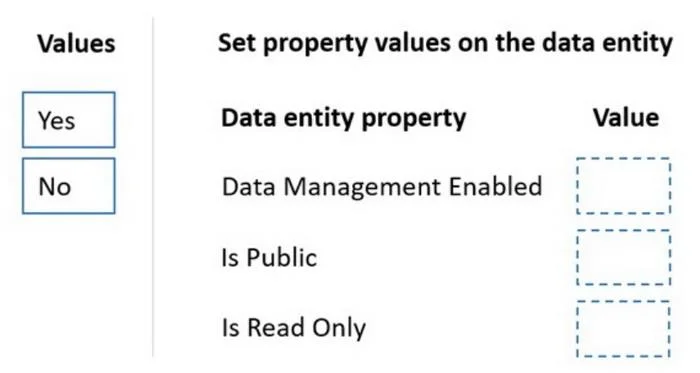
Answer Area
Drag items
Correct arrangement
- No
- Yes
- Yes
Explanation
Data Entity Properties for Purchase Order Inquiries
Context from Requirements
The key requirement driving all three property values:
"Purchase order inquiries must be exported using data packages. Users must be able to query using OData but should not be able to update or create data in the system."
Property-by-Property Breakdown
Property 1 → No (Write/Edit Capability)
This property controls whether users can create or update records through the entity.
- The requirement explicitly prohibits updates and creates via OData
- Setting this to No enforces a read-only contract at the entity level
- Common mistake: Confusing "read-only for OData" with disabling the entity entirely - the entity still needs to be active and queryable
Property 2 → Yes (Is Public / OData Enabled)
This property exposes the entity through the OData endpoint.
- The requirement states users must be able to query via OData
- Setting
Is Public = Yesregisters the entity with the OData metadata and makes it discoverable at/data/<EntityName> - Without this, the entity would only be accessible via data management, not OData queries
- Common mistake: Forgetting to set this and then wondering why the OData feed doesn't show the entity
Property 3 → Yes (Data Management Enabled)
This property makes the entity available for data package import/export.
- The requirement says inquiries must be exported using data packages
Data Management Enabled = Yesallows the entity to appear in the Data Management workspace and be included in data projects- Common mistake: Assuming OData exposure (
Is Public = Yes) also enables data packages - these are two separate properties serving different integration channels
Summary Table
| Property | Value | Driven By |
|---|---|---|
| Allow Create/Update (write capability) | No | "should not be able to update or create" |
| Is Public (OData) | Yes | "able to query using OData" |
| Data Management Enabled | Yes | "exported using data packages" |
Key Insight
OData querying and data package export are independent capabilities in D365 F&SCM - you must opt into both separately. A read-only OData entity that also supports data package export is a common pattern for reporting and integration scenarios like this one.
Topics
Community Discussion
No community discussion yet for this question.