
MB-500 · Question #196
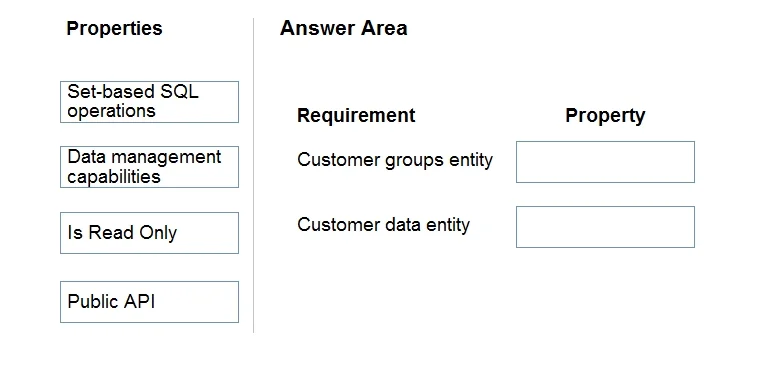
Drag and Drop Question A company uses Dynamics 365 Finance. You must create two data entities: - The first entity must allow access to customer groups by using OData. - The second entity must be…
The correct answer is Public API; Data management capabilities. Dynamics 365 Finance - Data Entity Properties Explained The Two Requirements | # | Requirement | Correct Property | |---|---|---| | 1 | OData access to customer groups | Public API | | 2 | Bulk export via batch process | Data management capabilities | --- Why Each Property Goes…
Question
Exhibit
Answer Area
Drag items
Correct arrangement
- Public API
- Data management capabilities
Explanation
Dynamics 365 Finance - Data Entity Properties Explained
The Two Requirements
| # | Requirement | Correct Property |
|---|---|---|
| 1 | OData access to customer groups | Public API |
| 2 | Bulk export via batch process | Data management capabilities |
Why Each Property Goes Where It Does
1. OData access → Public API
OData is a REST-based protocol that external apps and integrations use to query D365 Finance data. To expose a data entity over OData, you must enable the Public API property (IsPublic = Yes in the entity metadata). This registers the entity with the OData endpoint (/data/ route), making it discoverable and consumable by external clients. Without this, the entity is invisible to OData consumers regardless of any other setting.
2. Bulk export via batch process → Data management capabilities
The Data Management Framework (DMF), also called DIXF, handles bulk import/export operations - including scheduled batch exports. Enabling Data management capabilities (DataManagementEnabled = Yes) makes the entity available in the Data management workspace, where you can set up export projects, configure file formats, and run them as batch jobs. This is the mechanism behind recurring integrations and large-scale data movement.
Why the Other Options Don't Fit
- Set-based SQL operations - This is a performance optimization that enables set-based (RBAR-avoiding) processing inside DMF. It is subordinate to Data management capabilities, not a standalone requirement, and is not relevant to OData access.
- Is Read Only - This restricts write operations on an entity. It does not enable any access method; it only controls mutability. Neither requirement asks for read-only enforcement.
Common Misconceptions
- Confusing "Public API" with general visibility. Some assume any entity is automatically OData-accessible. It must be explicitly flagged with Public API.
- Using "Data management capabilities" for OData. DMF and OData are separate integration paths. DMF is batch/file-oriented; OData is request/response API-oriented. They serve different consumers.
- Thinking "Set-based SQL operations" enables bulk export. It only changes how DMF processes rows internally - it does not enable DMF access on its own.
Topics
Community Discussion
No community discussion yet for this question.