
MB-330 · Question #448
Drag and Drop Question A company is configuring the landed cost functionality in Dynamics 365 Supply Chain Management. The company requires configuration of a cost type code for several landed cost…
The correct answer is Variance accounts; Charge accrual accounts. Dynamics 365 Landed Cost - Cost Type Code Account Concepts Context In Dynamics 365 Supply Chain Management, Landed Cost tracks the full acquisition cost of goods (freight, duties, insurance, etc.). Cost type codes define how each landed cost is categorized and posted to the…
Question
Exhibit
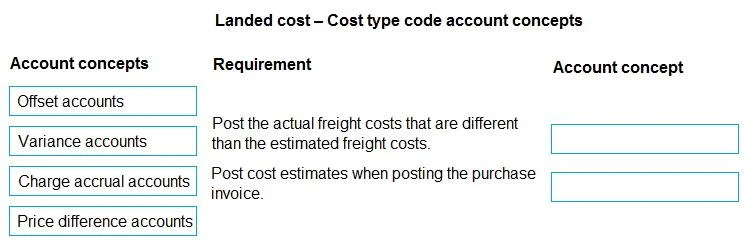
Answer Area
Drag items
Correct arrangement
- Variance accounts
- Charge accrual accounts
Explanation
Dynamics 365 Landed Cost - Cost Type Code Account Concepts
Context
In Dynamics 365 Supply Chain Management, Landed Cost tracks the full acquisition cost of goods (freight, duties, insurance, etc.). Cost type codes define how each landed cost is categorized and posted to the general ledger. The account concept assigned to a cost type code controls where amounts post under different circumstances.
The Two Requirements and Why Each Answer Fits
Requirement 1 → Variance accounts
When the actual vendor invoice for a landed cost arrives and differs from the estimated cost that was previously posted, the difference (variance) must be captured somewhere. Variance accounts absorb that delta - the gap between what was estimated at goods receipt and what was actually invoiced. This prevents the discrepancy from distorting inventory value or the original accrual.
Requirement 2 → Charge accrual accounts
Before the vendor's invoice is received, the system needs to estimate and accrue the expected landed cost (e.g., freight is estimated but the carrier invoice hasn't arrived). The charge accrual account holds this estimated liability temporarily. When the actual invoice posts, the accrual is reversed/cleared and replaced with the real amount.
Why the Other Options Don't Fit These Requirements
| Concept | Purpose | Why Not Selected Here |
|---|---|---|
| Offset accounts | The counterpart (debit/credit) side of a journal entry | Used as a balancing account, not for accruals or variance capture |
| Price difference accounts | Captures purchase price variance in standard costing scenarios | Specific to item price deviations, not landed cost estimation gaps |
Common Mistakes
- Confusing variance and charge accrual: Students often swap these. Remember: accrual happens first (before the invoice), variance happens after (when the real invoice differs from the accrual).
- Using "Offset accounts" for variances: Offset accounts are structural journal-entry mechanics, not variance capture mechanisms.
- Thinking price difference = variance: Price difference accounts relate to standard cost item pricing, not to landed cost estimate-vs-actual gaps.
Summary rule: Charge accrual = estimated cost holding account. Variance = the correction when reality diverges from the estimate.
Topics
Community Discussion
No community discussion yet for this question.