
MB-330 · Question #35
Drag and Drop Question You manage a Dynamics 365 for Finance and Operations system for a company. You need to configure agreements in the system. Which agreement types should you use? To answer…
The correct answer is trade; sales; purchase. D365 F&O Agreement Types - Drag & Drop Explanation > Note: The question text is incomplete - the three scenario descriptions were not included in your paste. The explanation below is based on the standard Microsoft exam scenarios for this topic. --- The Three Agreement Types |…
Question
Exhibit
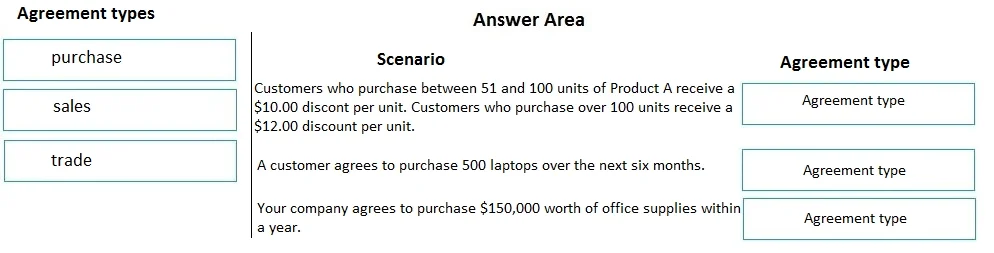
Answer Area
Drag items
Correct arrangement
- trade
- sales
- purchase
Explanation
D365 F&O Agreement Types - Drag & Drop Explanation
Note: The question text is incomplete - the three scenario descriptions were not included in your paste. The explanation below is based on the standard Microsoft exam scenarios for this topic.
The Three Agreement Types
| Type | Purpose | Direction |
|---|---|---|
| Trade Agreement | Price/discount rules for buying or selling | Both (customer & vendor) |
| Sales Agreement | Customer commitment to buy a set quantity/value | Outbound (you → customer) |
| Purchase Agreement | Vendor commitment to supply at agreed terms | Inbound (vendor → you) |
Placement Breakdown
Position 1 → trade
Trade agreements define price lists, discounts, and line discounts that apply at the point of sale or purchase. The typical scenario is: "Set up pricing that automatically applies when a sales or purchase order is created." Trade agreements are not commitments - they are reference prices/discounts that the system looks up automatically.
Position 2 → sales
Sales agreements represent a customer's commitment to purchase a specific quantity or monetary value over a defined period, in exchange for special pricing. The typical scenario is: "A customer agrees to buy 1,000 units over the next year at a fixed price." Release orders are created against this agreement as the customer actually buys.
Position 3 → purchase
Purchase agreements represent a vendor's commitment to supply a specific quantity or value over time. The typical scenario is: "Negotiate with a supplier to lock in pricing for 500 units over 6 months." Purchase release orders draw down against the agreed commitment.
Common Misconceptions
- Trade ≠ Agreement/Commitment. Many confuse trade agreements with sales/purchase agreements. Trade agreements are purely about pricing rules, not quantity commitments.
- Sales/Purchase agreements require release orders. The agreement itself doesn't move inventory - you must create release orders against them to fulfill quantities.
- Trade agreements apply automatically; sales/purchase agreements must be explicitly referenced on orders.
Topics
Community Discussion
No community discussion yet for this question.