
MB-330 · Question #151
Drag and Drop Question A company uses procurement in Dynamics 365 Supply Chain Management. You need to select the correct system functionalities to meet the company's requirements. Which system…
The correct answer is External catalog; Vendor catalog; Procurement catalog; Catalog policy rule. Important Note The question as provided is missing the business requirements (the left-side drop targets). Only the available items and their mapped positions are shown. I'll explain what each item does and the most common business scenarios they map to in D365 SCM exam…
Question
Exhibit
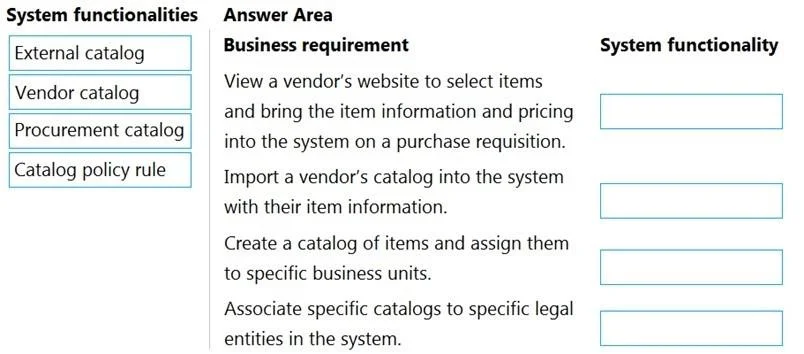
Answer Area
Drag items
Correct arrangement
- External catalog
- Vendor catalog
- Procurement catalog
- Catalog policy rule
Explanation
Important Note
The question as provided is missing the business requirements (the left-side drop targets). Only the available items and their mapped positions are shown. I'll explain what each item does and the most common business scenarios they map to in D365 SCM exam questions.
Concept Overview: The Four Catalog Tools
1. External Catalog
What it is: A vendor-hosted catalog accessed via PunchOut (cXML protocol). The employee "punches out" to the vendor's website, shops there, then returns the cart to D365 as a requisition line.
Typical requirement it satisfies: "Employees need to shop directly on a vendor's external website and import selections into purchase requisitions."
Why this and not Vendor Catalog? The key distinction is who hosts it. External = vendor hosts it outside D365.
2. Vendor Catalog
What it is: A catalog where vendors upload their product/price lists into D365 SCM. Procurement reviews and approves the content before it becomes available.
Typical requirement it satisfies: "Vendors should be able to submit and maintain their own product listings within the system for employee use."
Why this and not External Catalog? The catalog lives inside D365, but the vendor is the one populating it.
3. Procurement Catalog
What it is: An internal catalog created and managed entirely by the company's procurement team. It defines what categories and items employees can requisition.
Typical requirement it satisfies: "The procurement team needs to maintain an approved internal catalog for employee purchase requisitions."
Common misconception: People confuse this with Vendor Catalog. Remember: Procurement Catalog = company-owned and managed; Vendor Catalog = vendor-supplied content.
4. Catalog Policy Rule
What it is: A purchasing policy rule that controls which catalog (or which catalog categories/items) a specific legal entity, department, or employee can access.
Typical requirement it satisfies: "Restrict which employees or departments can see and order from specific catalogs or categories."
Common misconception: This is not a catalog itself - it's an access control mechanism layered on top of catalogs.
Key Differentiator Summary
| Feature | Who manages it? | Where does it live? | Controls access? |
|---|---|---|---|
| External Catalog | Vendor | Vendor's website | No |
| Vendor Catalog | Vendor | Inside D365 | No |
| Procurement Catalog | Company/Procurement team | Inside D365 | No |
| Catalog Policy Rule | Procurement admin | Inside D365 (policy) | Yes |
Recommendation: If you can share the actual business requirement descriptions (the left side of the drag-and-drop), I can give you precise, requirement-by-requirement matching explanations.
Topics
Community Discussion
No community discussion yet for this question.