
MB-310 · Question #436
Drag and Drop Question A company is implementing Dynamics 365 Finance. The company mandates that the ledger account track changes in its inventory balance sheet account throughout the packing slip…
The correct answer is Cost of units, delivered; Cost of units, invoiced. Dynamics 365 Finance: Inventory Posting Profile for Sales Orders The Core Requirement The company needs the inventory balance sheet account to reflect changes at both the packing slip and invoice stages. This is the critical constraint that drives the correct answer. --- The…
Question
Exhibit
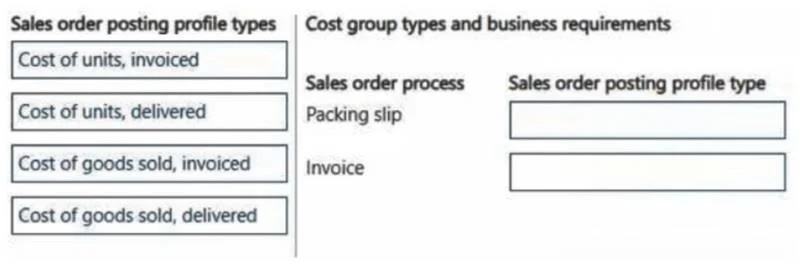
Answer Area
Drag items
Correct arrangement
- Cost of units, delivered
- Cost of units, invoiced
Explanation
Dynamics 365 Finance: Inventory Posting Profile for Sales Orders
The Core Requirement
The company needs the inventory balance sheet account to reflect changes at both the packing slip and invoice stages. This is the critical constraint that drives the correct answer.
The Two Posting Type Families
| Family | Posts to | Timing |
|---|---|---|
| Cost of units | Interim balance sheet account | Tracks the goods-in-transit between packing slip and invoice |
| Cost of goods sold | P&L / Income statement account | Goes directly to COGS, no interim balance sheet impact |
Placement 1: Packing Slip → Cost of units, delivered
When a packing slip is posted, the goods have left the warehouse but the customer hasn't been invoiced yet. Using Cost of units, delivered does this:
- Debit: Interim "cost of units delivered" account (a balance sheet account)
- Credit: Inventory account (balance sheet)
This keeps the transaction entirely on the balance sheet, which is exactly what the requirement asks for - the inventory balance sheet account reflects the change at packing slip time.
Why not "Cost of goods sold, delivered"? That posting type hits a P&L/COGS account directly at packing slip time, bypassing any interim balance sheet tracking. It wouldn't satisfy the requirement to track inventory balance sheet changes through the packing slip stage.
Placement 2: Invoice → Cost of units, invoiced
When the invoice is posted, this type completes the two-step cycle:
- Debit: COGS (P&L)
- Credit: Interim "cost of units delivered" account (reversing step 1)
The interim balance sheet account from step 1 is cleared, and the cost flows to P&L only at this final invoice stage.
Why not "Cost of goods sold, invoiced"? This skips the interim balance sheet entirely and is only valid when you didn't use "Cost of units, delivered" at the packing slip stage. It doesn't pair correctly with the two-step model required here.
The Two-Step Flow Summary
Packing Slip:  Inventory ──────────────► Interim B/S Account
                          (cost of units, delivered)

Invoice:       Interim B/S Account ────► COGS (P&L)
                          (cost of units, invoiced)
Common Mistakes
- Mixing families: Pairing "Cost of units, delivered" with "Cost of goods sold, invoiced" breaks the reversal cycle - the interim account never gets cleared.
- Choosing "Cost of goods sold" at packing slip: This is the most common wrong answer. It feels intuitive (goods are delivered, so recognize COGS), but it skips the interim balance sheet account the company explicitly requires.
- Reversing the timing: Assigning "invoiced" types to the packing slip process and vice versa - these are process-specific and cannot be swapped.
Topics
Community Discussion
No community discussion yet for this question.