MB-280 · Question #78
Drag and Drop Question You are implementing a new Dynamics 365 Customer Insights - Data environment for your organization. You complete ingesting the data you need to unify and navigate to the…
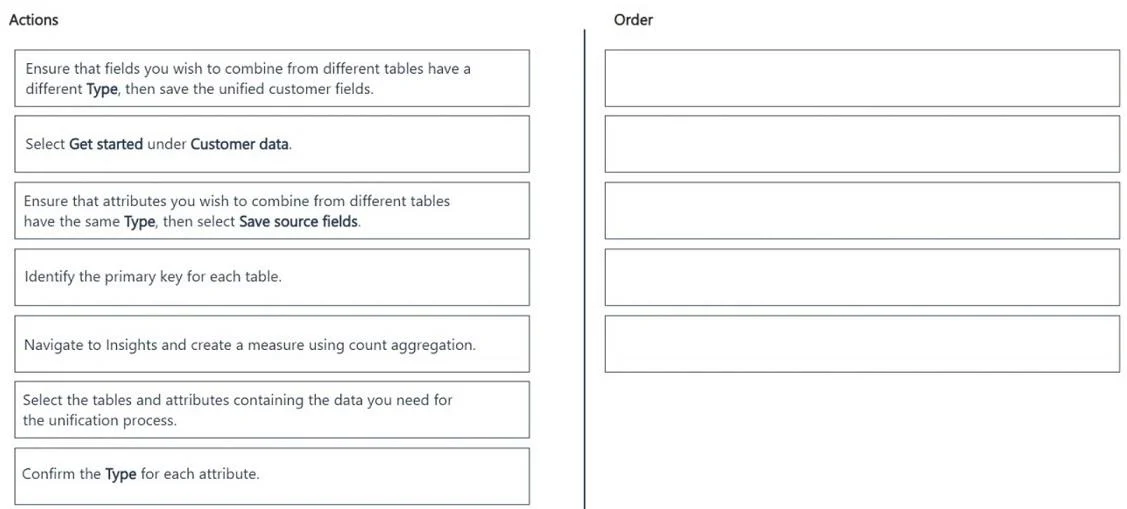
The correct answer is Select Get started under Customer data.; Select the tables and attributes containing the data you need for the unification process.; Identify the primary key for each table.; Ensure that attributes you wish to combine from different tables have the same Type, then select Save source fields.; Confirm the Type for each attribute. Dynamics 365 Customer Insights - Data: Unification Process Explained What This Question Tests This tests your knowledge of the first phase of data unification in Customer Insights - Data: the Source Fields (formerly "Map") step, where you define which data participates in…
Question
Exhibit
Answer Area
Drag items
Correct arrangement
- Select Get started under Customer data.
- Select the tables and attributes containing the data you need for the unification process.
- Identify the primary key for each table.
- Ensure that attributes you wish to combine from different tables have the same Type, then select Save source fields.
- Confirm the Type for each attribute.
Explanation
Dynamics 365 Customer Insights - Data: Unification Process Explained
What This Question Tests
This tests your knowledge of the first phase of data unification in Customer Insights - Data: the Source Fields (formerly "Map") step, where you define which data participates in building unified customer profiles.
Why Each Step Goes Where It Does
Step 1: Select Get started under Customer data
Why first: This is the literal entry point into the unification wizard. You cannot access any other unification UI without initiating it. "Customer data" is the specific section that begins source field configuration - not "Relationships" or "Enrichment."
Common mistake: Candidates sometimes confuse this with navigating to Insights first. Insights (measures, segments) come after unification is complete.
Step 2: Select the tables and attributes containing the data you need for the unification process
Why second: Before you can configure anything, you must tell the system what data to work with. You select which ingested tables and which columns (attributes) from those tables will participate in building the unified profile.
Common mistake: Assuming all ingested tables are automatically included - they are not. You explicitly choose tables and columns here.
Step 3: Identify the primary key for each table
Why third: Once tables are selected, the system needs a unique identifier per table to match and deduplicate records. You define this immediately after table selection because the primary key is a prerequisite for the matching logic that follows in later phases.
Common mistake: Thinking the primary key is set during ingestion. It may be available after ingestion, but it's designated for unification during this step.
Step 4: Ensure that attributes you wish to combine from different tables have the same Type, then select Save source fields
Why fourth: Customer Insights auto-detects semantic types (e.g., Person.FullName, Contact.Email). Before saving, you must verify that attributes you intend to merge across tables share the same semantic type - otherwise the system cannot map them together during the Merge phase. Once verified, you save the source fields configuration.
Common mistake: The distractor option says "Ensure fields have a different Type" - this is the opposite of correct. Fields to be combined must share the same type.
Step 5: Confirm the Type for each attribute
Why fifth: After saving, the system presents a review/confirmation view of the semantic type assigned to each attribute. This is a verification checkpoint - you confirm the auto-detected types are accurate before proceeding to the Match phase.
Common mistake: Many candidates expect this before step 4, thinking you'd confirm types before checking they match. In the actual UI flow, the save action in step 4 triggers the confirmation summary in step 5.
Eliminated Distractors
| Item | Why Eliminated |
|---|---|
| Navigate to Insights and create a measure | Measures are post-unification analytics - completely wrong phase |
| Ensure fields have a different Type | Factually incorrect - combined fields need the same type |
Key Takeaway
The flow is strictly: initiate → select data → set keys → align types & save → confirm types. Everything is sequential because each step feeds the next - you can't set primary keys without tables, and you can't validate types without attributes selected.
Topics
Community Discussion
No community discussion yet for this question.