
JN0-680 · Question #9
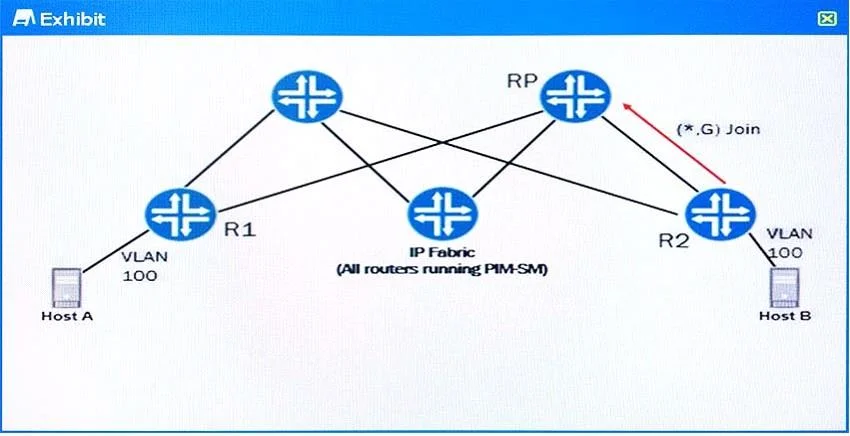
Referring to the exhibit, R1 and R2 are QFX5100s and are acting as VXLAN Layer 2 Gateways for VLAN 100 using PIM-SM signaling. What will cause R2 to send a (*.G) PIM Join towards the RP?
The correct answer is A. R2 will send a (*.G) PIM Join when its VLAN 100 configuration is committed. characteristics.html It's A because if you consider that Host B may send zero traffic whatsoever, how can Host A find Host B's MAC address? It would have to ARP for it. So, because Host B may lie dormant until Host A initiates communications, it is completely necessary for R2…
Question
Referring to the exhibit, R1 and R2 are QFX5100s and are acting as VXLAN Layer 2 Gateways for VLAN 100 using PIM-SM signaling. What will cause R2 to send a (*.G) PIM Join towards the RP?
Exhibit
Options
- AR2 will send a (*.G) PIM Join when its VLAN 100 configuration is committed.
- BR2 will send a (*.G) PIM Join when it first learns the MAC address of a locally attached host.
- CR2 will send a (*.G) PIM Join when it receives broadcast, multicast, or unknown unicast traffic
- DR2 will send a (*.G) PIM Join when it receives broadcast, multicast, or unknown unicast traffic
How the community answered
(60 responses)- A85% (51)
- B5% (3)
- C8% (5)
- D2% (1)
Explanation
characteristics.html It's A because if you consider that Host B may send zero traffic whatsoever, how can Host A find Host B's MAC address? It would have to ARP for it. So, because Host B may lie dormant until Host A initiates communications, it is completely necessary for R2 to (,G) PIM Join the VXLAN group for VLAN 100. C is impossible before the (,G), B and D are shades of the same chicken-and-egg scenario that makes A the only viable answer.
Topics
Community Discussion
No community discussion yet for this question.