
JN0-680 · Question #59
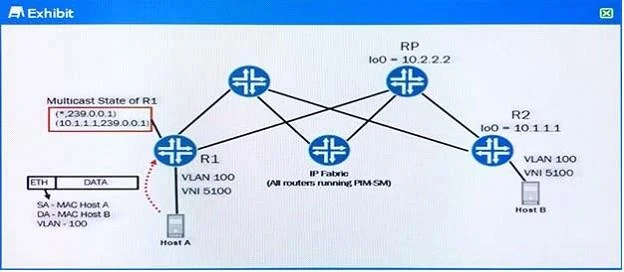
Referring to the exhibit, R1 and R2 are QFX5100 Series devices acting as VXLAN Layer 2 Gateways using PIM-SM signaling for the same VXLAN segment (VNI 5100). The multicast group assigned to VNI 5100…
The correct answer is A. R1 will send a VXLAN encapsulated Ethernet frame using 10.1.1.1 as the destination. Host A and B are on the same subnet, so communicating at Layer 2 ?MAC to MAC. The Layer 3 information is for VXLAN mapping to multicast groups ?so the destination address is 239.0.0.1 group, and the tree is source-based (R1 has (10.1.1.1,239.0.0.1) in its multicast table)…
Question
Referring to the exhibit, R1 and R2 are QFX5100 Series devices acting as VXLAN Layer 2 Gateways using PIM-SM signaling for the same VXLAN segment (VNI 5100). The multicast group assigned to VNI 5100 is 239.0.0.1. R1 currently has an entry in its MAC table for Host B. In this scenario, how will R1 react to receiving the Ethernet frame from Host A?
Exhibit
Options
- AR1 will send a VXLAN encapsulated Ethernet frame using 10.1.1.1 as the destination
- BR1 will send a VXLAN encapsulated Ethernet frame along the source-based multicast tree
- CR1 will send a VXLAN encapsulated Ethernet frame using 10.2.2.2 as the destination
- DR1 will send a VXLAN encapsulated Ethernet frame along the RP-based multicast tree using
How the community answered
(23 responses)- A87% (20)
- C9% (2)
- D4% (1)
Explanation
Host A and B are on the same subnet, so communicating at Layer 2 ?MAC to MAC. The Layer 3 information is for VXLAN mapping to multicast groups ?so the destination address is 239.0.0.1 group, and the tree is source-based (R1 has (10.1.1.1,239.0.0.1) in its multicast table). Assumption here the question infers Host A is sending a frame to Host B. Question poorly
Topics
Community Discussion
No community discussion yet for this question.