
HPE7-A08 · Question #45
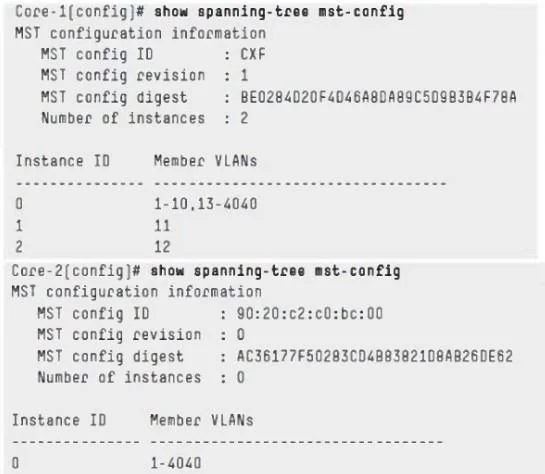
Refer to the exhibit. Both switches, Core-1 and Core-2, are configured with default spanning-tree priorities. Both switches appear as primary root bridges. What must be done to have only one…
The correct answer is B. Create matching MST configuration on Core-2. For MSTP, switches belong to the same spanning-tree domain only when they share an identical MST region configuration, which includes: VLAN-to-instance mappings Core-1 and Core-2 have different MST config IDs, revisions, digests, and instance mappings, so each forms its own MST…
Question
Refer to the exhibit. Both switches, Core-1 and Core-2, are configured with default spanning-tree priorities. Both switches appear as primary root bridges. What must be done to have only one spanning tree domain?
Exhibit
Options
- ACreate MST instances 1 and 2 on Core-2.
- BCreate matching MST configuration on Core-2.
- CSet the spanning tree priority to 1 on Core-1.
- DSet the spanning tree priority to 1 on Core-2.
How the community answered
(55 responses)- A11% (6)
- B58% (32)
- C25% (14)
- D5% (3)
Explanation
For MSTP, switches belong to the same spanning-tree domain only when they share an identical MST region configuration, which includes: VLAN-to-instance mappings Core-1 and Core-2 have different MST config IDs, revisions, digests, and instance mappings, so each forms its own MST region and becomes a root bridge independently. By configuring Core-2 with the same MST region parameters as Core-1, both switches will join the same MST region, allowing a single spanning-tree domain with a single root bridge.
Topics
Community Discussion
No community discussion yet for this question.