
HPE7-A08 · Question #202
Drag and Drop Question Place the problem-solving methodology steps in the correct order, with the first step starting at the top. Answer:
The correct answer is Identification; Analysis; Hypothesize; Implementation; Verification; Validation. Problem-Solving Methodology: Step-by-Step Explanation The Correct Order and Why --- 1. Identification You must know a problem exists before you can do anything else. This step is about recognizing and defining the problem - gathering initial symptoms, understanding what is…
Question
Drag and Drop Question Place the problem-solving methodology steps in the correct order, with the first step starting at the top. Answer:
Exhibit
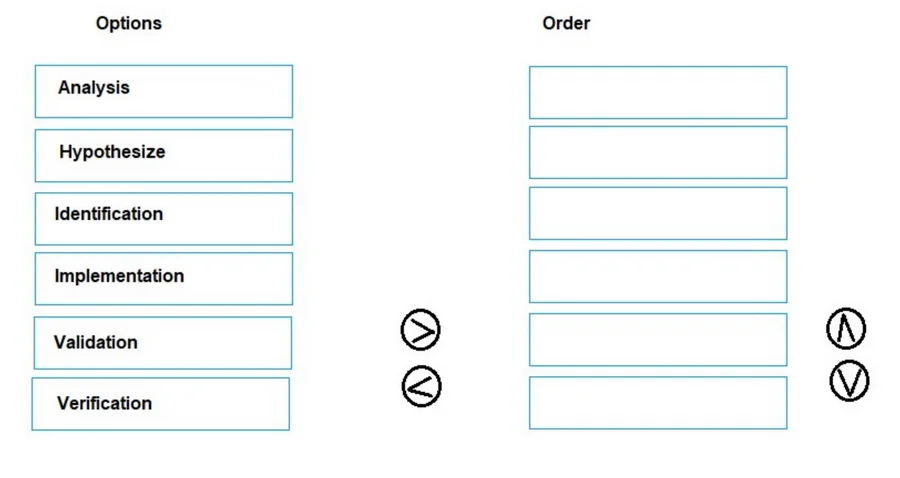
Answer Area
Drag items
Correct arrangement
- Identification
- Analysis
- Hypothesize
- Implementation
- Verification
- Validation
Explanation
Problem-Solving Methodology: Step-by-Step Explanation
The Correct Order and Why
1. Identification
You must know a problem exists before you can do anything else.
This step is about recognizing and defining the problem - gathering initial symptoms, understanding what is wrong, and scoping the issue. Without identification, there is no starting point. A common mistake is skipping straight to analysis or even a hypothesis before fully defining what problem you're actually trying to solve.
2. Analysis
You must understand the problem before theorizing causes.
After identifying the problem, you examine it in depth - reviewing data, logs, symptoms, affected components, and scope. Analysis gives you the factual foundation needed to form an intelligent hypothesis. Skipping analysis leads to guessing rather than reasoning.
3. Hypothesize
You form a theory only after you have evidence to reason from.
Based on your analysis, you propose a likely root cause or solution. This is informed speculation - not random guessing. A common mistake is hypothesizing before completing analysis, which wastes time chasing the wrong cause.
4. Implementation
You act on your hypothesis.
This is where you apply the fix, change, or solution derived from your hypothesis. Implementation comes after hypothesizing because you need a theory to act on. Acting before hypothesizing is trial-and-error, not methodology.
5. Verification
Did the implementation actually work?
Verification confirms that what you implemented resolved the specific problem you identified. It is narrow in scope - focused on the fix itself. A common mistake is confusing this with validation and stopping here.
6. Validation
Is the overall system correct and complete?
Validation is broader than verification. It confirms that the solution is correct in context - no regressions, no side effects, and the system behaves as expected end-to-end. Validation comes last because it can only be done after the fix is verified to work.
Key Distinctions to Remember
| Confusion Point | Clarification |
|---|---|
| Verification vs Validation | Verification = "did the fix work?" Validation = "is the whole system now right?" |
| Identification vs Analysis | Identification = "there is a problem." Analysis = "here is what the problem looks like in detail." |
| Analysis vs Hypothesize | Analysis gathers facts; Hypothesis interprets them into a theory. |
Most common exam mistake: Swapping Verification and Validation, or placing Hypothesize before Analysis.
Topics
Community Discussion
No community discussion yet for this question.