
HPE7-A08 · Question #128
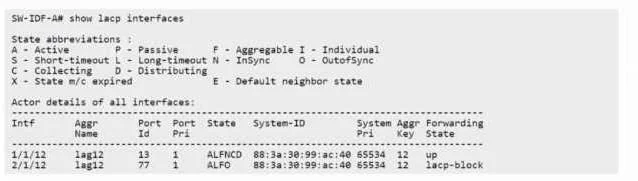
The output of the show LACP interfaces shows the following: What is causing this issue?
The correct answer is A. The AP is configured with LACP active. Option A is correct because when an AP is configured with LACP active mode, it initiates LACP PDU negotiations with the connected switch port. If the switch port is not configured for LACP (or is set to passive expecting the far end to remain silent), the negotiation fails…
Question
The output of the show LACP interfaces shows the following:
What is causing this issue?
Exhibit
Options
- AThe AP is configured with LACP active.
- BEach AP interface is connected to a routed-only interface on different networks.
- CSpanning tree and loop protect are enabled on both AP uplink ports.
- De0 is connected to a smart rate interface, and e is connected to a non-smart rate interface.
How the community answered
(49 responses)- A80% (39)
- B4% (2)
- C2% (1)
- D14% (7)
Explanation
Option A is correct because when an AP is configured with LACP active mode, it initiates LACP PDU negotiations with the connected switch port. If the switch port is not configured for LACP (or is set to passive expecting the far end to remain silent), the negotiation fails, resulting in the interface error state visible in the show LACP interfaces output - the AP is driving LAG negotiation when it shouldn't be.
Why the distractors are wrong:
- B is wrong because routed interfaces on different networks would produce routing/IP reachability errors, not an LACP-specific interface fault.
- C is wrong because spanning tree and loop protection operate at Layer 2 independently of LACP; their presence wouldn't manifest as an LACP negotiation failure in that output.
- D is wrong because a smart rate vs. non-smart rate mismatch is a physical/speed negotiation issue, not an LACP mode conflict - it wouldn't be the root cause shown in LACP interface state.
Memory tip: Think of LACP modes like a handshake: Active = "I'll start the conversation." If the AP is talking when it's supposed to listen (or the switch isn't expecting it), the link breaks. Remember - Active initiates, Passive waits - misplacing Active on the AP side causes the negotiation to fail.
Topics
Community Discussion
No community discussion yet for this question.