
HPE7-A08 · Question #127
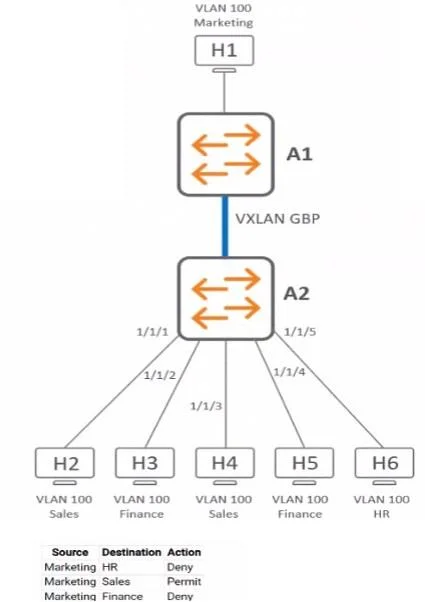
Refer to the exihibit. What is the expected behavior for ARP traffic sent from H1?
The correct answer is A. A2 will send the ARP traffic out of ports 1/1/1 and 1/1/3. ARP uses a broadcast destination (FF:FF:FF:FF:FF:FF), so a switch floods it out all ports in the same VLAN as the source - excluding the ingress port. Based on the exhibit, only ports 1/1/1 and 1/1/3 share H1's VLAN on A2, so those are the only ports that receive the flooded…
Question
Refer to the exihibit. What is the expected behavior for ARP traffic sent from H1?
Exhibit
Options
- AA2 will send the ARP traffic out of ports 1/1/1 and 1/1/3.
- BA2 will send the ARP traffic out of ports 1/1/1-1/1/4.
- CA2 will drop the ARP traffic.
- DA2 will flood the ARP traffic out of all interfaces.
How the community answered
(29 responses)- A69% (20)
- B3% (1)
- C7% (2)
- D21% (6)
Explanation
ARP uses a broadcast destination (FF:FF:FF:FF:FF:FF), so a switch floods it out all ports in the same VLAN as the source - excluding the ingress port. Based on the exhibit, only ports 1/1/1 and 1/1/3 share H1's VLAN on A2, so those are the only ports that receive the flooded ARP.
Why the distractors fail:
- B is wrong because ports 1/1/2 and 1/1/4 belong to a different VLAN, so A2 correctly excludes them - VLAN boundaries contain broadcast domains.
- C is wrong because switches do not drop ARP broadcasts by default; dropping would only occur with specific ACLs or ARP inspection policies blocking the traffic.
- D is wrong because "all interfaces" ignores VLAN segmentation - a core function of managed switches is to keep broadcast domains separated per VLAN.
Memory tip: Think of a VLAN as a bubble - broadcasts (like ARP) stay inside the bubble. A switch only floods out ports that share the same bubble as the sender, never across bubble boundaries.
Topics
Community Discussion
No community discussion yet for this question.