
HPE7-A06 · Question #7
The customer is experiencing periodic uplink congestion between campus-1's AGG-1 and core. This has been negatively affecting voice communications. The VoIP phones edge mark packets with DSCP EF…
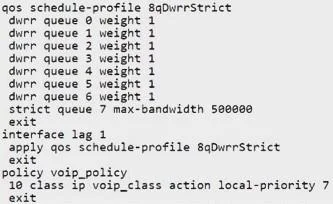
The correct answer is A. qos schedule-profile 8QDwrwStrict dwr queue 0 weight 1 dwr queue 1 weight 1 dwr queue 2 weight 1 dwr queue 3 weight 1 dwr queue 4 weight 1 dwr queue 5 weight 1 dwr queue 6 weight 1 strict queue 7 max-bandwidth 500000 exit interface lag 1 apply qos schedule-profile 8QDwrwStrict exit policy voip_policy 10 class ip voip_class action local-priority 7 exit. The policy already classifies VoIP traffic (DSCP EF) and sets local-priority 6. To ensure reliable forwarding during congestion, that traffic must be mapped into a strict priority queue on the uplink (LAG1). Script A configures queue 7 as a strict priority queue with a…
Question
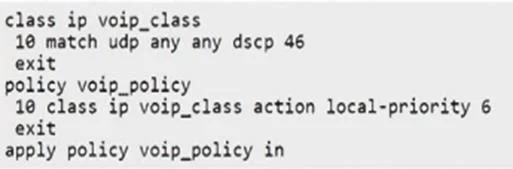
The customer is experiencing periodic uplink congestion between campus-1’s AGG-1 and core. This has been negatively affecting voice communications. The VoIP phones edge mark packets with DSCP EF. The uplink from AGG-1 to core is LAG1. The customer has already configured the following class and policy on AGG-1:
Based on this policy, which script, when deployed on AGG-1, will improve the reliable forwarding of voice traffic between AGG-1 and its uplink to the core? A. B. C. D.
Exhibits
Options
- Aqos schedule-profile 8QDwrwStrict dwr queue 0 weight 1 dwr queue 1 weight 1 dwr queue 2 weight 1 dwr queue 3 weight 1 dwr queue 4 weight 1 dwr queue 5 weight 1 dwr queue 6 weight 1 strict queue 7 max-bandwidth 500000 exit interface lag 1 apply qos schedule-profile 8QDwrwStrict exit policy voip_policy 10 class ip voip_class action local-priority 7 exit
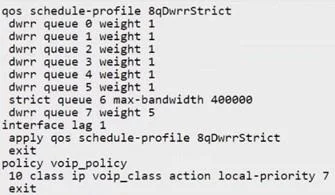
- Bqos schedule-profile 8QDwrwStrict dwr queue 0 weight 1 dwr queue 1 weight 1 dwr queue 2 weight 1 dwr queue 3 weight 1 dwr queue 4 weight 1 dwr queue 5 weight 1 strict queue 6 max-bandwidth 400000 dwr queue 7 weight 5 interface lag 1 apply qos schedule-profile 8QDwrwStrict exit policy voip_policy 10 class ip voip_class action local-priority 7 exit
- Cqos schedule-profile 8QDwrwStrict dwr queue 0 weight 1 dwr queue 1 weight 1 dwr queue 2 weight 1 dwr queue 3 weight 1 dwr queue 4 weight 1 dwr queue 5 weight 1 strict queue 6 max-bandwidth 300000 strict queue 7 exit apply qos schedule-profile 8QDwrwStrict
- Dqos schedule-profile 8QDwrwStrict dwr queue 0 weight 1 dwr queue 1 weight 1 dwr queue 2 weight 1 dwr queue 3 weight 1 dwr queue 4 weight 1 dwr queue 5 weight 1 strict queue 6 max-bandwidth 500000 dwr queue 7 weight 1 apply qos schedule-profile 8QDwrwStrict
How the community answered
(51 responses)- A59% (30)
- B24% (12)
- C6% (3)
- D12% (6)
Explanation
The policy already classifies VoIP traffic (DSCP EF) and sets local-priority 6. To ensure reliable forwarding during congestion, that traffic must be mapped into a strict priority queue on the uplink (LAG1). Script A configures queue 7 as a strict priority queue with a bandwidth limit, and applies the schedule profile to LAG1, ensuring voice traffic is dequeued before other traffic. This guarantees low latency and jitter for VoIP.
Topics
Community Discussion
No community discussion yet for this question.