
HPE6-A85 · Question #102
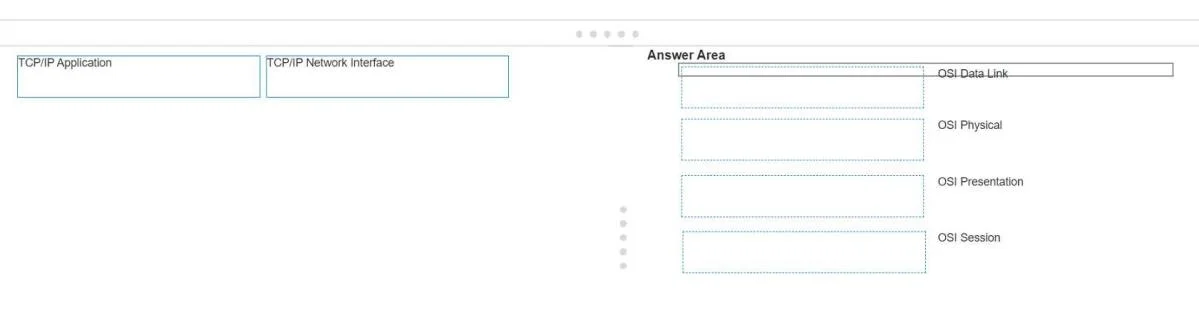
Drag and Drop Question Match the Open Systems Interconnection (OSI) layer with its comparable member of the TCP/IP stack. (Options may be used more than once.) Answer:
The correct answer is TCP/IP Network Interface; TCP/IP Network Interface; TCP/IP Application; TCP/IP Application. OSI to TCP/IP Layer Mapping The question asks you to match 4 OSI layers to their TCP/IP equivalents. The TCP/IP model collapses several OSI layers, which is the core concept being tested. The available TCP/IP layers here are intentionally limited to Network Interface and…
Question
Drag and Drop Question Match the Open Systems Interconnection (OSI) layer with its comparable member of the TCP/IP stack. (Options may be used more than once.) Answer:
Exhibit
Answer Area
Drag items
Correct arrangement
- TCP/IP Network Interface
- TCP/IP Network Interface
- TCP/IP Application
- TCP/IP Application
Explanation
OSI to TCP/IP Layer Mapping
The question asks you to match 4 OSI layers to their TCP/IP equivalents. The TCP/IP model collapses several OSI layers, which is the core concept being tested.
The available TCP/IP layers here are intentionally limited to Network Interface and Application - the two "multi-OSI" layers. The middle TCP/IP layers (Internet and Transport) map 1:1 with OSI Network and Transport, so they're excluded.
The 4 OSI layers and their placements:
| Position | OSI Layer | → TCP/IP Equivalent | Reason |
|---|---|---|---|
| 1 | Physical | Network Interface | Handles raw bit transmission; TCP/IP combines this with Data Link |
| 2 | Data Link | Network Interface | Handles MAC addressing/framing; merged with Physical in TCP/IP |
| 3 | Session | Application | Manages sessions/dialogues; TCP/IP rolls this into Application |
| 4 | Presentation | Application | Handles encoding/encryption; also absorbed into TCP/IP Application |
Why two layers map to each TCP/IP layer
TCP/IP Network Interface = OSI Physical + Data Link
- TCP/IP was designed pragmatically. Physical hardware and local framing are treated as one unit since they're tightly coupled.
TCP/IP Application = OSI Session + Presentation + Application
- Protocols like HTTP, FTP, and TLS handle sessions and encoding within the application layer - no separate OSI-style separation exists.
Common misconceptions
- "TCP/IP has a 1:1 OSI mapping" - It doesn't. TCP/IP has 4 layers; OSI has 7. The top 3 OSI layers and bottom 2 OSI layers are each collapsed.
- Forgetting OSI Transport and Network are NOT in this question - They map cleanly (Transport→Transport, Network→Internet) so they're excluded here precisely because they aren't the tricky ones.
- Mixing up Data Link vs. Network - Data Link (Layer 2) goes to Network Interface, not TCP/IP Internet. Only OSI Layer 3 (Network) maps to TCP/IP Internet.
Topics
Community Discussion
No community discussion yet for this question.