HPE6-A85 · Question #103
Drag and Drop Question Match the most cost-effective option for cabling each requirement. (All lengths indicate total cable length including patch cable(s), service loops, etc. where used.) Answer…
The correct answer is Cat 5e cable; Cat 6a cable; DAC/Direct Attach Copper (DAC) cable; Multimode fiber; single mode fiber. Important Note About This Question The question is incomplete. The actual requirements/scenarios (what each cable needs to be matched to) are missing - they've been replaced by advertisement spam text. Only the cable options and their final arrangement are shown, without the…
Question
Drag and Drop Question Match the most cost-effective option for cabling each requirement. (All lengths indicate total cable length including patch cable(s), service loops, etc. where used.) Answer:
Exam Questions, Study Guides, Practice Tests. Lead the way to help you pass any IT Certification exams, 100% Pass Guaranteed or Full Refund. Especially Cisco, Microsoft, CompTIA, Citrix, EMC, HP, Oracle, VMware, Juniper, Check Point, LPI, Nortel, EXIN and so on. Our Slogan: First Test, First Pass. Help you to pass any IT Certification exams at the first try. You can reach us at any of the email addresses listed below. Any problems about IT certification or our products, you could rely upon us, we will give you satisfactory answers in 24 hours.
Exhibit
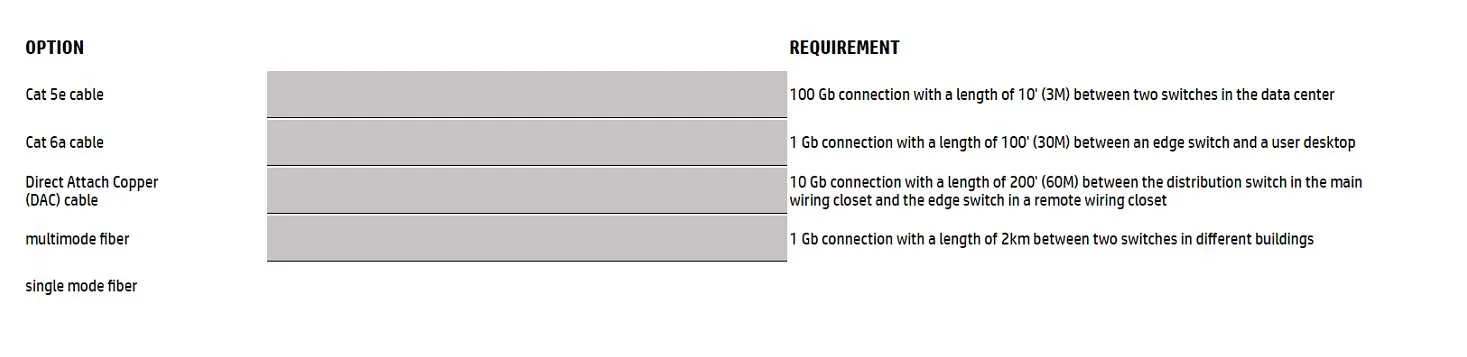
Answer Area
Drag items
Correct arrangement
- Cat 5e cable
- Cat 6a cable
- DAC/Direct Attach Copper (DAC) cable
- Multimode fiber
- single mode fiber
Explanation
Important Note About This Question
The question is incomplete. The actual requirements/scenarios (what each cable needs to be matched to) are missing - they've been replaced by advertisement spam text. Only the cable options and their final arrangement are shown, without the numbered scenarios they correspond to.
This appears to be from a low-quality "brain dump" site, which also means the answer arrangement may not even be accurate without context.
What I Can Explain: Cable Types and Their Cost-Effective Use Cases
Here's why each cable type exists and when it's the cost-effective choice:
Cat 5e
- Use case: Standard 1GbE runs up to 100m in offices/buildings
- Why it wins: Cheapest structured cabling option for everyday LAN needs
- Common mistake: Assuming you need Cat 6a for everything - Cat 5e handles most workstation connections just fine
Cat 6a
- Use case: 10GbE runs up to 100m (e.g., to access points or high-demand servers)
- Why it wins: Cost-effective 10G option when runs exceed the DAC cable's short range
- Common mistake: Confusing Cat 6 (max 55m at 10G) with Cat 6a (full 100m at 10G)
Direct Attach Copper (DAC)
- Use case: Very short runs (1–7m) between switches, servers, or storage in a rack or adjacent racks
- Why it wins: Cheapest way to connect 10G/25G/40G/100G devices at short distances - no SFP transceivers needed separately
- Common mistake: Trying to use DAC beyond ~7m; it's passive and signal degrades quickly
Multimode Fiber
- Use case: Intra-building runs of ~100–400m (e.g., between floors or IDF to MDF)
- Why it wins: Cost-effective fiber option for medium distances where copper won't reach
- Common mistake: Using single-mode when multimode would suffice - single-mode transceivers cost significantly more
Single Mode Fiber
- Use case: Long distances (hundreds of meters to kilometers) - campus backbone, WAN links
- Why it wins: Only viable option at those distances; no alternative
- Common mistake: Assuming it's interchangeable with multimode - the fiber core size and transceivers are different and incompatible
Bottom Line
To properly answer this question, you need the actual requirement descriptions (distances, speeds, environments). I'd recommend finding the original exam objective source (CompTIA Network+, CCNA, etc.) rather than relying on this dump site.
Topics
Community Discussion
No community discussion yet for this question.
