
HPE6-A85 · Question #101
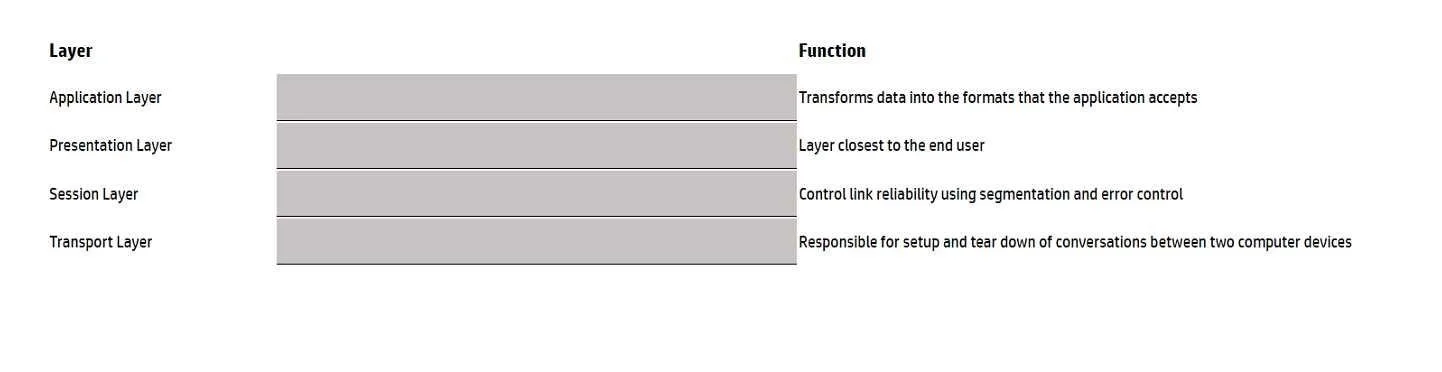
Drag and Drop Question Match the Open Systems Interconnection (OSI) layer with its function. Answer:
The correct answer is Transforms data into the format that the application accepts; Layer closest to the end user; Provides reliability, flow segmentation and error control; Responsible for setup and tear down of conversations between two computer devices. OSI Layer Matching - Explanation This question covers Layers 4–7 of the OSI model. Here's what each item maps to and why: --- The Matches | Position | Function | OSI Layer | |----------|----------|-----------| | 1 | Transforms data into the format that the application accepts |…
Question
Drag and Drop Question Match the Open Systems Interconnection (OSI) layer with its function. Answer:
Exhibit
Answer Area
Drag items
Correct arrangement
- Transforms data into the format that the application accepts
- Layer closest to the end user
- Provides reliability, flow segmentation and error control
- Responsible for setup and tear down of conversations between two computer devices
Explanation
OSI Layer Matching - Explanation
This question covers Layers 4–7 of the OSI model. Here's what each item maps to and why:
The Matches
| Position | Function | OSI Layer |
|---|---|---|
| 1 | Transforms data into the format that the application accepts | Layer 6 - Presentation |
| 2 | Layer closest to the end user | Layer 7 - Application |
| 3 | Provides reliability, flow segmentation and error control | Layer 4 - Transport |
| 4 | Responsible for setup and tear down of conversations between two devices | Layer 5 - Session |
Item-by-Item Breakdown
1. "Transforms data into the format that the application accepts" → Presentation Layer (6)
The Presentation layer is the translator. It handles data encoding (e.g., ASCII, Unicode), encryption/decryption (SSL/TLS), and compression. It takes raw data from the Session layer and converts it into a format the Application layer can consume - and vice versa on the receiving end.
2. "Layer closest to the end user" → Application Layer (7)
Layer 7 is the topmost layer and the only one that directly interacts with end-user software (browsers, email clients, etc.). Protocols like HTTP, FTP, DNS, and SMTP operate here. "Closest to the end user" is its defining characteristic.
3. "Provides reliability, flow segmentation and error control" → Transport Layer (4)
The Transport layer (TCP/UDP) handles end-to-end communication reliability. TCP specifically provides:
- Segmentation - breaks data into segments
- Flow control - prevents sender from overwhelming receiver
- Error control - acknowledgments and retransmission of lost data
4. "Responsible for setup and tear down of conversations" → Session Layer (5)
The Session layer manages logical sessions (persistent connections) between two hosts. It establishes, maintains, synchronizes, and terminates dialogues. Think of it as managing the "phone call" itself - not the words spoken (Application) or how they're encoded (Presentation), but the act of opening and closing the connection.
Common Mistakes
- Confusing Session (5) with Transport (4): Transport creates the channel; Session manages the conversation over time. Session adds checkpointing and dialog control on top.
- Confusing Presentation (6) with Application (7): Application is where the user's software lives. Presentation is the formatting/encryption layer below it - users don't directly see Layer 6.
- Thinking "closest to user" means Layer 1: The OSI model runs 1 (Physical) to 7 (Application). Higher numbers = closer to the user.
Topics
Community Discussion
No community discussion yet for this question.