
HPE2-T37 · Question #3
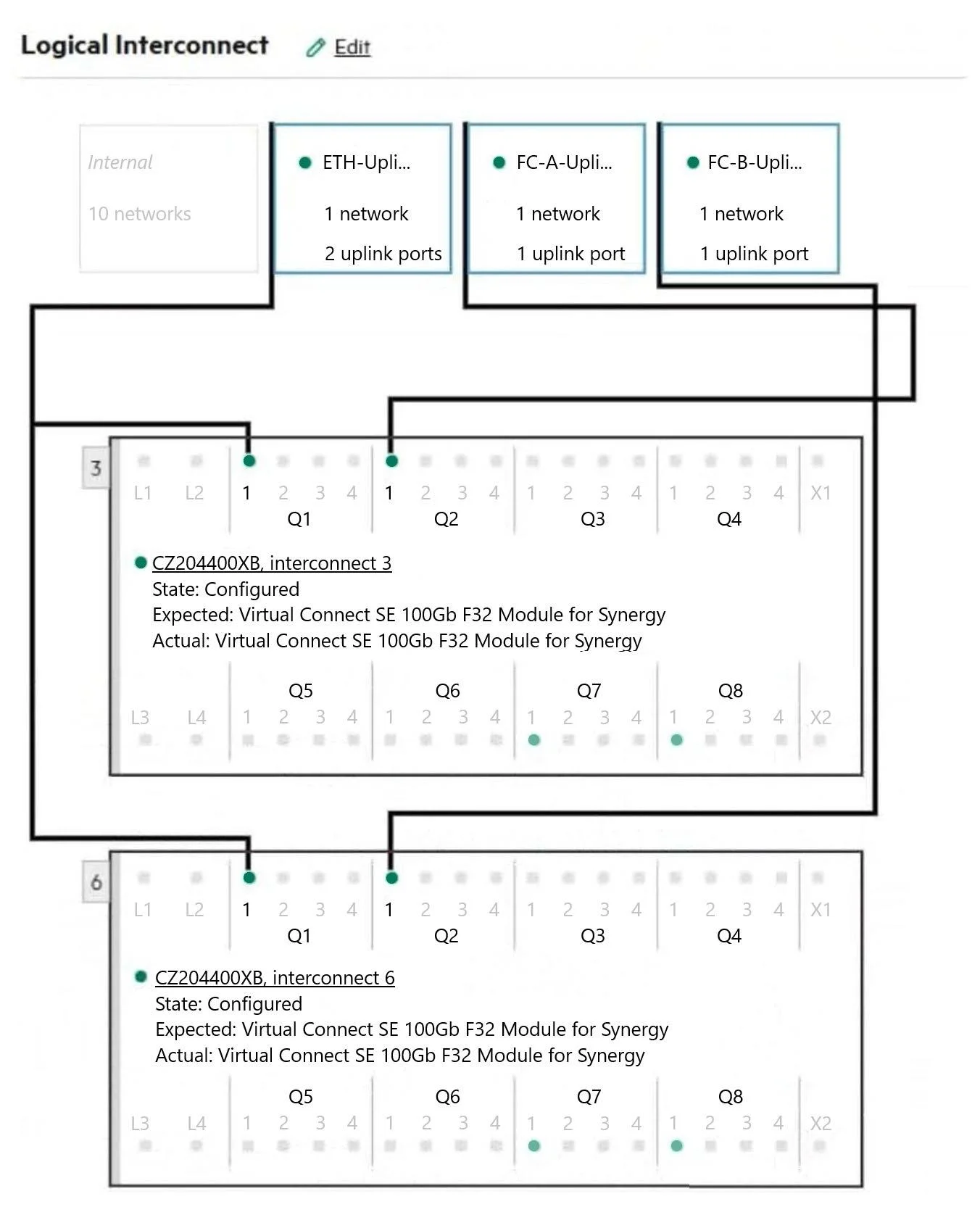
Refer to the exhibit. Which statement about the logical interconnect shown is true?
The correct answer is C. Additional uplink ports can be added to ETH-Uplink to increase available bandwidth. Option C is correct because Ethernet uplink sets in HPE logical interconnects support link aggregation - you can add more physical ports to the existing ETH-Uplink set to distribute traffic and increase total available bandwidth, making it a flexible, scalable design. Why the…
Question
Refer to the exhibit. Which statement about the logical interconnect shown is true?
Exhibit
Options
- AFor FC uplink sets, an additional uplink from second module should be added for redundancy.
- BThe maximum supported number of the internal networks for logical interconnect is configured.
- CAdditional uplink ports can be added to ETH-Uplink to increase available bandwidth.
- DFC uplinks are not supported and will be converted to FCoE or RoCE uplinks.
How the community answered
(49 responses)- A2% (1)
- B6% (3)
- C82% (40)
- D10% (5)
Explanation
Option C is correct because Ethernet uplink sets in HPE logical interconnects support link aggregation - you can add more physical ports to the existing ETH-Uplink set to distribute traffic and increase total available bandwidth, making it a flexible, scalable design.
Why the distractors are wrong:
- A is incorrect because the exhibit shows FC uplinks already present on both interconnect modules, so redundancy is already achieved - no additional uplink is needed.
- B is incorrect because the internal networks shown in the exhibit are well below the supported maximum limit; the logical interconnect is not at capacity.
- D is incorrect because native FC uplinks are supported on HPE Virtual Connect/Synergy interconnect modules - no forced conversion to FCoE or RoCE occurs.
Memory tip: Remember "ETH = Expandable" - Ethernet uplink sets are the flexible component where you can always bolt on more ports to grow bandwidth, while FC uplinks handle SAN connectivity natively and independently.
Topics
Community Discussion
No community discussion yet for this question.