
HPE0-V25 · Question #51
Drag and Drop Question Review the Exhibit: Match the definition to each colored boxed acronym from the image. Answer:
The correct answer is Class of Raid Controller; Smart Array Series; Number of SAS lanes; Port Type; Controller Type (form factor). HP Smart Array RAID Controller Naming Convention This question tests your ability to decode the HP/HPE Smart Array controller model number - each segment of the name has a specific technical meaning. A typical model looks like: P408i-a --- The 5-Position Breakdown | Position |…
Question
Exhibit
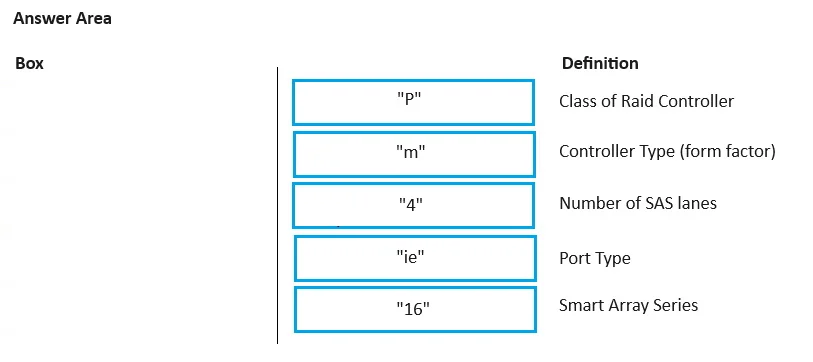
Answer Area
Drag items
Correct arrangement
- Class of Raid Controller
- Smart Array Series
- Number of SAS lanes
- Port Type
- Controller Type (form factor)
Explanation
HP Smart Array RAID Controller Naming Convention
This question tests your ability to decode the HP/HPE Smart Array controller model number - each segment of the name has a specific technical meaning.
A typical model looks like: P408i-a
The 5-Position Breakdown
| Position | Answer | Example Character | Meaning |
|---|---|---|---|
| 1 | Class of RAID Controller | P | Performance tier |
| 2 | Smart Array Series | 4 | 400-series generation |
| 3 | Number of SAS lanes | 08 | 8 SAS lanes available |
| 4 | Port Type | i | Internal ports |
| 5 | Controller Type (form factor) | a | Standup/standard PCIe |
Position-by-Position Explanation
1. Class of RAID Controller (P, E, H, B)
The leading letter defines the performance/feature tier. P = Performance (enterprise), E = Entry-level, H = HBA-mode capable, B = Basic embedded. This comes first because it defines the product family.
2. Smart Array Series (4, 8, etc.)
The first digit indicates the generation/series (e.g., 400-series, 800-series). Higher = newer generation with more features.
3. Number of SAS Lanes (08, 16, etc.)
The middle digit(s) indicate lane/port count, which directly maps to how many drives the controller can address natively.
4. Port Type (i, e, ie)
i= Internal ports onlye= External ports onlyie= Both internal and external This determines cabling and enclosure compatibility.
5. Controller Type / Form Factor (a, ar, p)
a= Standup (standard PCIe slot)ar= AROC (modular/mezzanine for blades)p= Plug-in card variant This comes last because it describes the physical installation method.
Common Mistakes
- Confusing position 3 and 4 - students swap "lanes" and "port type" since both relate to connectivity. Remember: count comes before direction (how many, then which way).
- Thinking position 1 is the series - the letter is the class tier, not the generation number. The series number follows it.
- Ignoring form factor entirely - on blades vs. rack servers this matters significantly for compatibility; it's not just cosmetic.
Topics
Community Discussion
No community discussion yet for this question.