
HP
HPE0-V25 · Question #52
Drag and Drop Question Match the protocol to a fundamental approach for storing data. (Each option may be used once, more than once, or not at all.) Answer:
The correct answer is NAS; SAN; NAS; SAN. NAS vs SAN - Storage Fundamentals Note: The question is missing the actual category labels for positions 1–4. Based on the arrangement and the topic ("fundamental approaches for storing data"), the most common version of this exam question maps to these categories: | Position |…
Plan and Design HPE Hybrid Cloud Solutions
Question
Drag and Drop Question Match the protocol to a fundamental approach for storing data. (Each option may be used once, more than once, or not at all.) Answer:
Exhibit
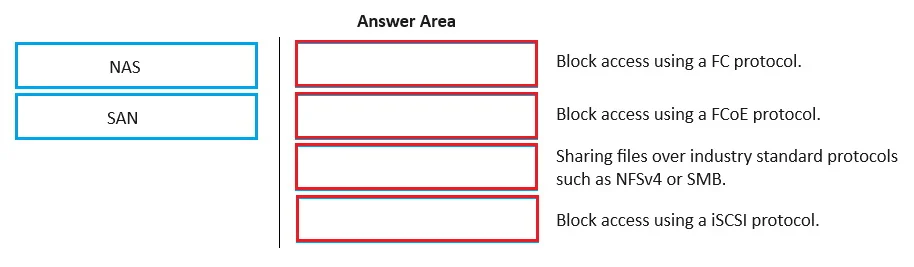
Answer Area
Drag items
NASSAN
Correct arrangement
- NAS
- SAN
- NAS
- SAN
Explanation
NAS vs SAN - Storage Fundamentals
Note: The question is missing the actual category labels for positions 1–4. Based on the arrangement and the topic ("fundamental approaches for storing data"), the most common version of this exam question maps to these categories:
| Position | Category | Answer |
|---|---|---|
| 1 | File-level storage | NAS |
| 2 | Block-level storage | SAN |
| 3 | Uses SMB/NFS protocols | NAS |
| 4 | Uses iSCSI / Fibre Channel | SAN |
Core Concepts
NAS (Network Attached Storage)
- Operates at the file level - the storage device manages the file system and serves complete files to clients
- Communicates over standard IP networks using SMB (Windows) or NFS (Linux/Unix)
- Clients request "give me this file" - the NAS handles where and how it's stored
- Easy to set up, great for shared file access across many users
SAN (Storage Area Network)
- Operates at the block level - presents raw disk blocks to the server, which manages its own file system on top
- Uses Fibre Channel (dedicated high-speed fabric) or iSCSI (block storage over TCP/IP)
- The server "sees" the SAN disk as if it were a locally attached drive
- High performance, low latency - used for databases, VMs, mission-critical workloads
Why Each Position
- NAS - File-level = NAS by definition. It abstracts storage behind a file system the device itself controls.
- SAN - Block-level = SAN by definition. Raw blocks, no file system overhead from the storage device.
- NAS - SMB/NFS are file-sharing protocols running over Ethernet/IP - that's NAS's native transport.
- SAN - iSCSI/Fibre Channel are block transport protocols - the defining transports of a SAN.
Common Misconceptions
- "iSCSI uses IP, so it must be NAS" - Wrong. iSCSI carries block data over IP. The transport (IP) doesn't determine the level (block vs file). NAS uses IP too, but serves files.
- "SAN requires Fibre Channel" - Not anymore. iSCSI SANs are common and cheaper. The key is block-level access, not the specific transport.
- "NAS is slower so it's less important" - Context-dependent. NAS is ideal for file sharing; SAN is ideal for performance-critical block I/O like databases.
Topics
#storage protocols#block storage#file storage#object storage
Community Discussion
No community discussion yet for this question.