
HPE0-V25 · Question #48
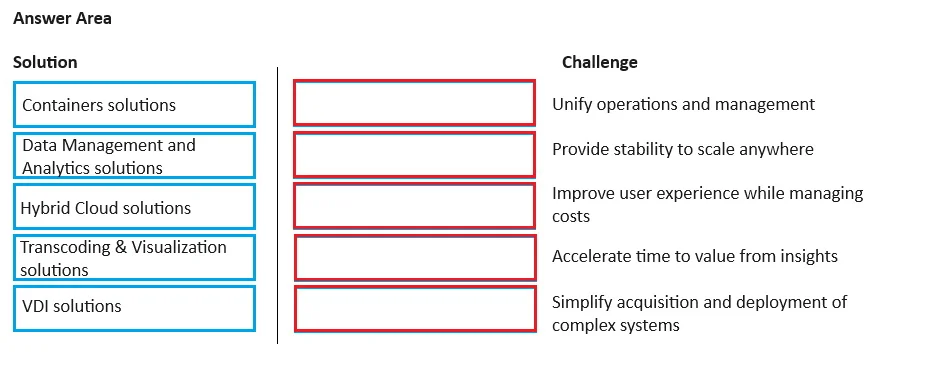
Drag and Drop Question Map the HPE platform and workload-oriented solutions with the customer's challenge. Answer:
The correct answer is Hybrid Cloud solutions maps to Unify operations and management; Transcoding & Visualization solutions maps to Provide stability to scale anywhere; VDI solutions maps to Improve user experience while managing costs; Data Management and Analytics solutions maps to Accelerate time to value from insights; Containers solutions maps to Simplify acquisition and deployment of complex systems. HPE Solutions Mapped to Customer Challenges --- 1. Hybrid Cloud solutions → Unify operations and management Hybrid Cloud is fundamentally about bridging on-premises infrastructure with public/private clouds under a single operational pane of glass. HPE's GreenLake platform, for…
Question
Drag and Drop Question Map the HPE platform and workload-oriented solutions with the customer's challenge. Answer:
Exhibit
Answer Area
Drag items
Correct arrangement
- Hybrid Cloud solutions maps to Unify operations and management
- Transcoding & Visualization solutions maps to Provide stability to scale anywhere
- VDI solutions maps to Improve user experience while managing costs
- Data Management and Analytics solutions maps to Accelerate time to value from insights
- Containers solutions maps to Simplify acquisition and deployment of complex systems
Explanation
HPE Solutions Mapped to Customer Challenges
1. Hybrid Cloud solutions → Unify operations and management
Hybrid Cloud is fundamentally about bridging on-premises infrastructure with public/private clouds under a single operational pane of glass. HPE's GreenLake platform, for example, delivers a consistent cloud experience across environments. The customer challenge here is fragmentation - different tools, policies, and teams for different environments. Hybrid Cloud directly solves operational silos.
Common mistake: Confusing this with Containers, which also spans environments but focuses on deployment, not operational unification.
2. Transcoding & Visualization solutions → Provide stability to scale anywhere
Transcoding (converting media formats) and visualization (rendering complex graphics) are computationally intensive and latency-sensitive workloads. These solutions rely on high-performance, GPU-accelerated infrastructure that must remain stable under variable load (e.g., live broadcast peaks, real-time 3D rendering). "Scale anywhere" reflects the need to handle bursty demand without quality degradation.
Common mistake: Associating "scale anywhere" with Hybrid Cloud. Hybrid Cloud unifies management; this is about raw compute stability at scale for demanding media workloads.
3. VDI solutions → Improve user experience while managing costs
Virtual Desktop Infrastructure (VDI) delivers desktops as a service to end users. The persistent tension in VDI is user experience vs. infrastructure cost - too few resources and users get laggy desktops; over-provisioning wastes budget. HPE VDI solutions optimize resource pooling to maintain responsiveness while keeping per-seat costs controlled.
Common mistake: Thinking VDI maps to "Unify operations." VDI does centralize desktops, but the primary driver is end-user productivity and cost efficiency, not operational unification.
4. Data Management and Analytics solutions → Accelerate time to value from insights
Data is only valuable when it can be processed, analyzed, and acted upon quickly. HPE's data management and analytics portfolio (including storage, data fabric, and analytics acceleration) reduces the time between data ingestion and actionable insight - directly addressing the "time to value" challenge. This includes eliminating data silos and optimizing pipelines.
Common mistake: Confusing this with Containers (which can run analytics workloads). The distinction is that Data Management solutions address the data lifecycle and pipeline, not the deployment mechanism.
5. Containers solutions → Simplify acquisition and deployment of complex systems
Containers (e.g., Kubernetes, HPE Ezmeral) package applications with all their dependencies, enabling repeatable, standardized deployment regardless of the underlying environment. For customers running complex, multi-component workloads, containers dramatically reduce the complexity of provisioning and deploying systems - turning what was a weeks-long process into a predictable, automated one.
Common mistake: Associating containers with "Unify operations and management." While container orchestration does have management aspects, the core customer value here is deployment simplicity and acquisition standardization, not broad operational unification.
Summary Table
| HPE Solution | Customer Challenge | Core Reason |
|---|---|---|
| Hybrid Cloud | Unify operations & management | Single control plane across environments |
| Transcoding & Visualization | Stability to scale anywhere | GPU-intensive, latency-sensitive at variable scale |
| VDI | Improve UX while managing costs | Centralized desktops with cost/performance balance |
| Data Management & Analytics | Accelerate time to value from insights | Faster data pipelines → faster decisions |
| Containers | Simplify acquisition & deployment | Portable, reproducible packaging of complex systems |
Topics
Community Discussion
No community discussion yet for this question.