
HPE0-S59 · Question #71
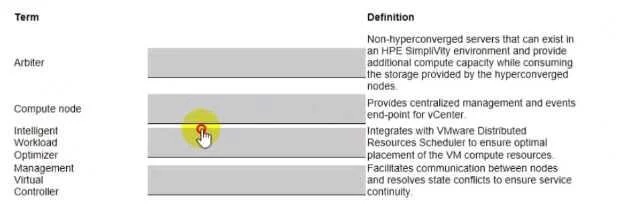
Drag and Drop Question Match HPE SimpliVity team with the definition. Answer:
The correct answer is Compute node; Intelligent Workload Optimizer; Management Virtual Controller; Arbiter. HPE SimpliVity Components - Drag-and-Drop Explanation > Note: The question matches each item to a definition box (positions 1–4). The definitions aren't shown in your prompt, but the correct mapping can be explained by what each component actually does. --- Position 1 → Compute…
Question
Drag and Drop Question Match HPE SimpliVity team with the definition. Answer:
Exhibit
Answer Area
Drag items
Correct arrangement
- Compute node
- Intelligent Workload Optimizer
- Management Virtual Controller
- Arbiter
Explanation
HPE SimpliVity Components - Drag-and-Drop Explanation
Note: The question matches each item to a definition box (positions 1–4). The definitions aren't shown in your prompt, but the correct mapping can be explained by what each component actually does.
Position 1 → Compute Node
A compute node is a standard server that contributes CPU and RAM to the SimpliVity federation but does not run the OmniStack Data Virtualization software. It offloads all storage and data services to neighboring SimpliVity nodes.
- Common misconception: Students confuse this with a full SimpliVity node. A compute node has no local data services - it's purely a resource donor.
Position 2 → Intelligent Workload Optimizer
The Intelligent Workload Optimizer (IWO) analyzes VM workload patterns and automatically moves or places workloads across the federation to maximize performance and resource efficiency.
- Common misconception: Confusing IWO with a load balancer. IWO is workload-aware and predictive, not just reactive to thresholds.
Position 3 → Management Virtual Controller
The Management Virtual Controller (related to the OmniStack Virtual Controller / OVC) is the VM running on each SimpliVity node that provides centralized data services - deduplication, compression, backup, and management functions.
- Common misconception: Thinking there's only one per cluster. Each SimpliVity node runs its own OVC/management controller.
Position 4 → Arbiter
The Arbiter is a lightweight software service deployed outside the SimpliVity federation that acts as a quorum tiebreaker. It prevents split-brain scenarios when nodes lose connectivity with each other.
- Key distinction: The Arbiter stores no data - it only casts tie-breaking votes for quorum decisions.
- Common misconception: Thinking the Arbiter is a management tool. It has no administrative function; its sole role is maintaining cluster consensus.
Summary Table
| Position | Component | Core Role |
|---|---|---|
| 1 | Compute node | CPU/RAM only, no OmniStack software |
| 2 | Intelligent Workload Optimizer | VM placement & performance optimization |
| 3 | Management Virtual Controller | Data services + management per node |
| 4 | Arbiter | Quorum tiebreaker, no data storage |
Topics
Community Discussion
No community discussion yet for this question.