
HPE0-S54 · Question #110
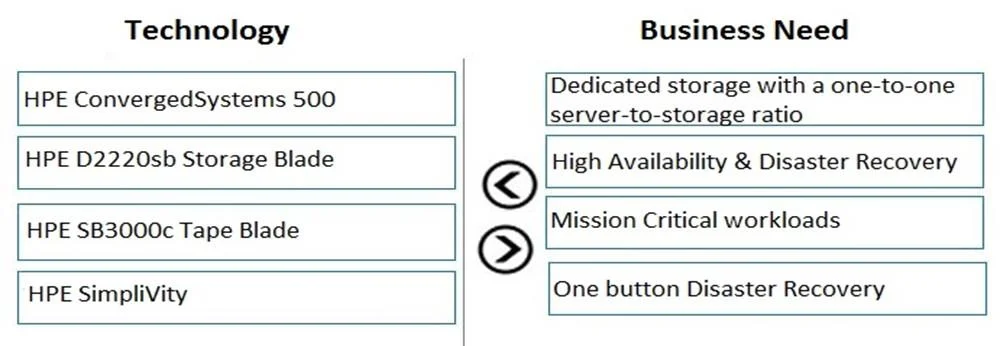
Drag and Drop Question Match each HPE technology solution to the customer's business need that it can fulfill. Answer:
The correct answer is HPE D2220sb Storage Blade: Dedicated storage with a one-to-one server-to-storage ratio; HPE SimpliVity: One button Disaster Recovery; HPE ConvergedSystems 500: Mission Critical workloads; HPE SB3000c Tape Blade: High Availability & Disaster Recovery. HPE Technology Solutions - Matching Explained --- 1. HPE D2220sb Storage Blade → Dedicated storage with a one-to-one server-to-storage ratio The D2220sb is a storage blade that installs directly inside an HPE BladeSystem enclosure alongside server blades. It provides…
Question
Drag and Drop Question Match each HPE technology solution to the customer's business need that it can fulfill. Answer:
Exhibit
Answer Area
Drag items
Correct arrangement
- HPE D2220sb Storage Blade: Dedicated storage with a one-to-one server-to-storage ratio
- HPE SimpliVity: One button Disaster Recovery
- HPE ConvergedSystems 500: Mission Critical workloads
- HPE SB3000c Tape Blade: High Availability & Disaster Recovery
Explanation
HPE Technology Solutions - Matching Explained
1. HPE D2220sb Storage Blade → Dedicated storage with a one-to-one server-to-storage ratio
The D2220sb is a storage blade that installs directly inside an HPE BladeSystem enclosure alongside server blades. It provides Direct-Attached Storage (DAS) - each server blade gets its own dedicated storage module. This physical architecture means one storage blade per server blade, which is the literal definition of a one-to-one server-to-storage ratio. It does not participate in a shared storage pool.
Common misconception: Students sometimes assume any blade storage is shared (like a SAN). The D2220sb is dedicated, not shared.
2. HPE SimpliVity → One button Disaster Recovery
SimpliVity is HPE's hyperconverged infrastructure (HCI) platform. Its signature differentiator is built-in data protection with near-instantaneous backup and recovery. Specifically, HPE SimpliVity's RapidDR feature allows administrators to recover entire virtual machines or a full remote site with minimal interaction - effectively "one button DR." Backups are always stored in a deduplicated, compressed format ready for instant restore.
Common misconception: Students may associate SimpliVity with "Mission Critical" because HCI is powerful. However, in HPE's product positioning, the one-button DR story is SimpliVity's exam-tested identity.
3. HPE ConvergedSystems 500 → Mission Critical workloads
The ConvergedSystem 500 (CS500) is a pre-validated, fully integrated system engineered for enterprise-grade, mission-critical applications such as SAP HANA, Oracle DB, and large ERP platforms. It delivers the highest levels of Reliability, Availability, and Serviceability (RAS), with validated configurations that reduce risk in demanding production environments.
Common misconception: Students may confuse this with a general-purpose converged system. The CS500 is specifically scoped to workloads where downtime is unacceptable and validated performance is required.
4. HPE SB3000c Tape Blade → High Availability & Disaster Recovery
The SB3000c is a tape drive blade that fits into the HPE BladeSystem chassis. Tape has long been the backbone of enterprise backup and recovery strategies. In the exam context, tape-based backup within a blade chassis directly supports Disaster Recovery by providing reliable, offline, sequential backup copies. The "High Availability" component refers to having a recovery path when primary systems fail.
Common misconception: Students sometimes dismiss tape as "old technology" and struggle to map it to HA&DR. In HPE's exam framing, tape backup = DR capability - it is the recovery mechanism that enables HA continuity after failure.
Quick Reference Table
| HPE Solution | Business Need | Key Reason |
|---|---|---|
| D2220sb Storage Blade | 1:1 server-to-storage ratio | Direct-attached, dedicated blade storage |
| SimpliVity | One button Disaster Recovery | RapidDR, built-in HCI data protection |
| ConvergedSystems 500 | Mission Critical workloads | Pre-validated, max RAS, enterprise apps |
| SB3000c Tape Blade | HA & Disaster Recovery | Tape backup = recovery mechanism for DR |
Topics
Community Discussion
No community discussion yet for this question.