
HPE0-S54 · Question #112
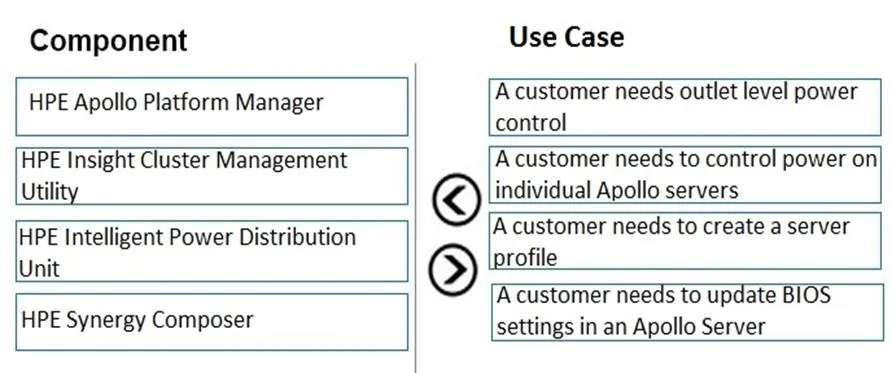
Drag and Drop Question Match the use case to the management component they should use. Answer:
The correct answer is HPE Intelligent Power Distribution Unit - A customer needs outlet level power control; HPE Apollo Platform Manager - A customer needs to control power on individual Apollo servers; HPE Synergy Composer - A customer needs to create a server profile; HPE Insight Cluster Management Utility - A customer needs to update BIOS settings in an Apollo Server. HPE Management Components - Matching Explanation The Correct Matches --- 1. HPE Intelligent Power Distribution Unit → Outlet level power control The iPDU is a smart power strip/distribution unit that sits in the rack and manages power at the individual outlet level. It can…
Question
Drag and Drop Question Match the use case to the management component they should use. Answer:
Exhibit
Answer Area
Drag items
Correct arrangement
- HPE Intelligent Power Distribution Unit - A customer needs outlet level power control
- HPE Apollo Platform Manager - A customer needs to control power on individual Apollo servers
- HPE Synergy Composer - A customer needs to create a server profile
- HPE Insight Cluster Management Utility - A customer needs to update BIOS settings in an Apollo Server
Explanation
HPE Management Components - Matching Explanation
The Correct Matches
1. HPE Intelligent Power Distribution Unit → Outlet level power control
The iPDU is a smart power strip/distribution unit that sits in the rack and manages power at the individual outlet level. It can remotely power on/off/cycle specific outlets, monitor per-outlet wattage, and enforce power budgets. This is the only component in the list that operates at outlet granularity - it's literally a PDU.
2. HPE Apollo Platform Manager → Control power on individual Apollo servers
The Apollo Platform Manager (APM) is firmware/software built specifically for HPE Apollo systems. It manages power and cooling at the chassis/server node level within an Apollo enclosure. Unlike the iPDU (which controls rack outlets), APM understands Apollo-specific hardware topology and lets you power individual server nodes on or off within that chassis.
Key distinction from iPDU: APM is Apollo-aware and server-aware; iPDU is outlet-aware and hardware-agnostic.
3. HPE Synergy Composer → Create a server profile
HPE Synergy Composer is the management appliance for the HPE Synergy composable infrastructure platform. Server profiles are a Synergy-native concept - they define firmware, connections, storage, and BIOS settings as a portable template that can be applied to any compute module. Synergy Composer is the only component here that supports server profiles, as that abstraction doesn't exist in Apollo or traditional ProLiant management.
4. HPE Insight Cluster Management Utility → Update BIOS settings on an Apollo server
CMU (Cluster Management Utility) is HPE's HPC cluster management tool designed to manage large numbers of nodes at scale. It includes capabilities to push BIOS/firmware configurations across many Apollo nodes simultaneously - which is exactly what you need in an HPC/Apollo environment where you might manage hundreds of servers. It integrates with iLO to make BIOS changes remotely.
Common Mistakes & Misconceptions
| Mistake | Why It's Wrong |
|---|---|
| Confusing iPDU with APM for server power control | iPDU controls outlets, not servers - it doesn't know what's plugged in |
| Thinking Synergy Composer manages Apollo | Synergy Composer is Synergy-only; Apollo has its own toolset |
| Using iLO directly instead of CMU for BIOS at scale | iLO works per-server; CMU is for fleet-wide configuration in Apollo/HPC |
| Assuming APM handles BIOS | APM focuses on power and cooling within the Apollo chassis, not firmware configuration |
Quick Memory Aid
iPDU = rack outlet power | APM = Apollo node power | Composer = Synergy profiles | CMU = Apollo BIOS/cluster config
Topics
Community Discussion
No community discussion yet for this question.