nerdexam
HP

HPE0-S52 · Question #56

Drag and Drop Question Match the HPE ProLiant Gen10 servers to the intended workload. Select and Place: Correct Answer: Section: (none) Explanation Explanation/Reference:

HPE ProLiant Gen10 Server Workload Matching Key Concepts First DL = rack-mounted (DataLine), optimized for density and compute ML = tower form factor (MicroLine), optimized for local storage expansion Higher model numbers generally indicate more capability/scalability --- Each…

Plan and design HPE Server Solutions

Question

Drag and Drop Question Match the HPE ProLiant Gen10 servers to the intended workload. Select and Place:

Correct Answer:

Section: (none) Explanation Explanation/Reference:

Exhibit
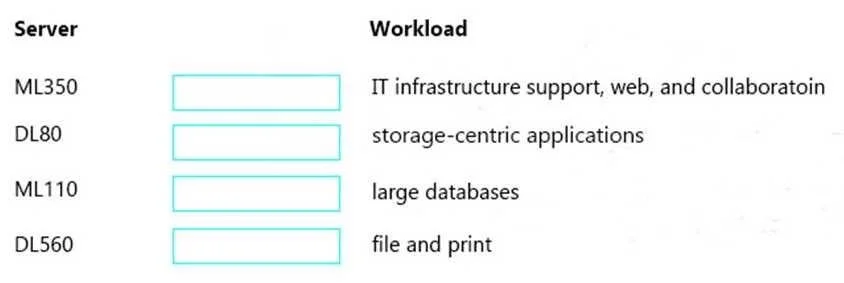
HPE0-S52 question #56 exhibit

Explanation

HPE ProLiant Gen10 Server Workload Matching

Key Concepts First

  • DL = rack-mounted (DataLine), optimized for density and compute
  • ML = tower form factor (MicroLine), optimized for local storage expansion
  • Higher model numbers generally indicate more capability/scalability

Each Placement Explained

1. DL80 → File and Print

The DL80 is a 1U, single-socket entry-level rack server targeting SMB environments. File and print workloads are low-compute, low-memory tasks - they don't need powerful CPUs or large RAM pools. The DL80's modest scalability and low cost make it ideal for this light-duty, cost-sensitive role. Overpowering file/print with a bigger server wastes budget.

2. DL560 → IT Infrastructure Support, Web, and Collaboration

The DL560 is a 4-socket rack server capable of hosting many CPU cores and large memory pools simultaneously. Web and collaboration platforms (think SharePoint, Exchange, virtualized infrastructure) require high concurrency - serving many users at once across multiple threads. Four sockets give it the parallelism to handle this without becoming a bottleneck.

3. ML110 → Storage-Centric Applications

Tower servers (ML series) have physically larger chassis, which means more drive bays and easier internal storage expansion than equivalent rack units. The ML110 is an entry-level tower that trades compute density for storage accessibility - perfect for workloads where raw capacity and local drive expandability matter more than CPU firepower.

4. ML350 → Large Databases

The ML350 is HPE's mid-to-high-range tower, supporting dual processors and up to ~3TB of RAM in Gen10 configurations. Large databases (SQL Server, Oracle) demand massive memory headroom to cache working datasets and strong CPU performance for complex queries. The ML350 delivers both, making it the right match.


Common Mistakes

MistakeWhy It's Wrong
Mapping DL560 to large databasesDL560's 4-socket strength is parallelism/concurrency, not memory-optimized single workloads
Mapping ML350 to web/collaborationML350 is overkill for concurrency but right-sized for memory-hungry databases
Assuming DL > ML for storageTower form factors physically accommodate more drives; rack wins on compute density, not storage expansion
Putting DL80 on any heavy workloadIt's entry-level by design - only appropriate for lightweight, low-traffic roles

Topics

#ProLiant Gen10#workload matching#server families#use case alignment

Community Discussion

No community discussion yet for this question.

Full HPE0-S52 Practice