nerdexam
HP

HPE0-S52 · Question #55

Drag and Drop Question Match each HPE ProLiant server to its correct definition. Select and Place: Correct Answer: Section: (none) Explanation Explanation/Reference:

HPE ProLiant Server Family - Drag-and-Drop Explanation The Mappings Explained 1. BL Server → Blade servers that fit within the HPE BladeSystem BL = Blade. BL servers are half-height or full-height blades that slide into the HPE BladeSystem c-Class chassis (c7000 or c3000). They…

Plan and design HPE Server Solutions

Question

Drag and Drop Question Match each HPE ProLiant server to its correct definition. Select and Place:

Correct Answer:

Section: (none) Explanation Explanation/Reference:

Exhibit
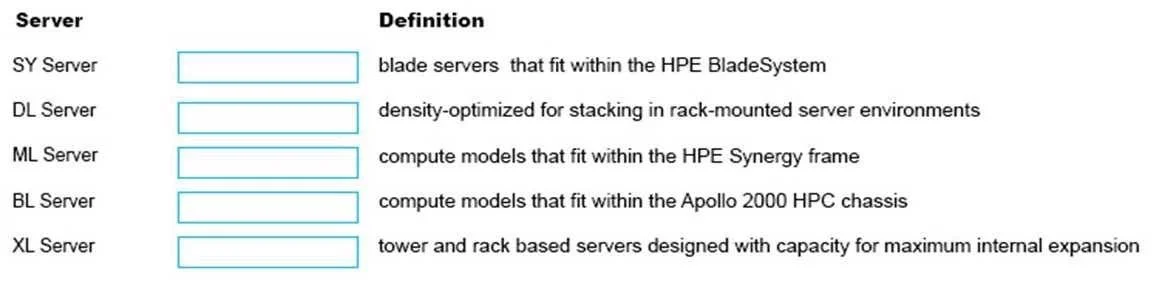
HPE0-S52 question #55 exhibit

Explanation

HPE ProLiant Server Family - Drag-and-Drop Explanation

The Mappings Explained

1. BL Server → Blade servers that fit within the HPE BladeSystem

BL = Blade. BL servers are half-height or full-height blades that slide into the HPE BladeSystem c-Class chassis (c7000 or c3000). They share power, cooling, and networking infrastructure within the enclosure. The naming is the most intuitive of the group.


2. DL Server → Compute models that fit within the Apollo 2000 HPC chassis

Likely Exam Error - Flag This

This mapping is almost certainly incorrect in the source material. In standard HPE nomenclature:

  • DL = traditional standalone rack servers (e.g., DL360, DL380). "DL" historically relates to rack/dense form factors.
  • The Apollo 2000 chassis actually houses XL servers (e.g., XL170r, XL190r).

If your exam states this, memorize it for the test - but know that real-world HPE documentation maps XL → Apollo 2000, not DL.


3. ML Server → Tower and rack-based servers designed for maximum internal capacity

ML = Modular/tower. ML servers (e.g., ML110, ML350) are tower-form-factor servers prioritizing internal expansion: more drive bays, PCIe slots, and storage capacity than rack-optimized models. They can often be rack-mounted with a conversion kit.


4. SY Server → Compute models that fit within the HPE Synergy frame

SY = Synergy. These are compute modules for HPE's composable infrastructure platform, the Synergy 12000 Frame. Unlike BladeSystem, Synergy uses software-defined pooling of compute, storage, and networking resources.


5. XL Server → Density-optimized for stacking in rack-mounted server environments

XL = Hyperscale/high-density. XL servers (part of the Apollo family) pack maximum compute density into a rack. As noted above, XL servers like the XL170r and XL190r are the actual compute nodes for the Apollo 2000 chassis - so items 2 and 5 appear swapped in this answer key.


Common Mistakes

ConfusionWhy it happens
BL vs SYBoth are chassis-based; BL = BladeSystem (older), SY = Synergy (composable)
DL vs XLBoth are rack-related; DL = standalone rack, XL = high-density/Apollo chassis
ML assumed to be "mini"ML is actually for maximum expansion, not minimal footprint

Bottom line: For this specific exam, memorize the mappings as given. But be aware that the DL ↔ XL definitions appear to be swapped compared to HPE's official product documentation.

Topics

#ProLiant server families#DL ML SY CL#server definitions#form factor selection

Community Discussion

No community discussion yet for this question.

Full HPE0-S52 Practice