
H12-323_V2.0 · Question #107
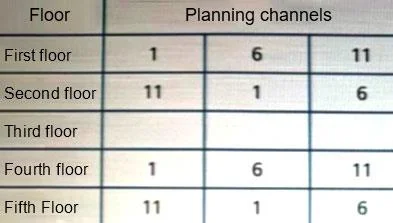
As shown in the figure, this is a schematic diagram of AP channel planning for a certain enterprise floor, and the planning has been completed for some floors. It has been confirmed that the 2.4G…
The correct answer is C. 6, 11, 1. Option C (6, 11, 1) is correct because 2.4GHz has exactly three non-overlapping channels - 1, 6, and 11 - each separated by 5 channels to prevent spectral overlap. The specific order (6, 11, 1 rather than 1, 6, 11) is dictated by the already-planned floors in the diagram: the…
Question
As shown in the figure, this is a schematic diagram of AP channel planning for a certain enterprise floor, and the planning has been completed for some floors. It has been confirmed that the 2.4G frequency band channels will be used for deployment, and co- channel interference must be avoided. Which of the following is the most reasonable channel planning for the third floor?
Exhibit
Options
- A13, 2, 7
- B1, 6, 11
- C6, 11, 1
- D5, 9, 1
How the community answered
(27 responses)- A15% (4)
- B4% (1)
- C70% (19)
- D11% (3)
Explanation
Option C (6, 11, 1) is correct because 2.4GHz has exactly three non-overlapping channels - 1, 6, and 11 - each separated by 5 channels to prevent spectral overlap. The specific order (6, 11, 1 rather than 1, 6, 11) is dictated by the already-planned floors in the diagram: the third floor's AP positions must be mapped so that no AP shares a channel with the AP directly above or below it on an adjacent floor, avoiding vertical co-channel interference.
Why the distractors fail:
- A (13, 2, 7): Channel 13 is region-restricted (unavailable in North America and some other regions) and this set deviates from the universal standard non-overlapping trio.
- B (1, 6, 11): Uses the correct channels but in the wrong spatial order - this arrangement would place the same channel directly above/below an AP on an adjacent floor, creating vertical co-channel interference with the pre-planned floors.
- D (5, 9, 1): Channels 1→5 and 5→9 are only 4 apart, so they overlap spectrally and will cause co-channel interference.
Memory tip: Lock in "1 – 6 – 11" as the only three non-overlapping 2.4GHz channels (count: +5, +5). On multi-floor deployments, rotate the order per floor so vertically stacked APs always differ in channel - the exam will test whether you pick the right rotation, not just the right channels.
Topics
Community Discussion
No community discussion yet for this question.