
H12-323_V2.0 · Question #106
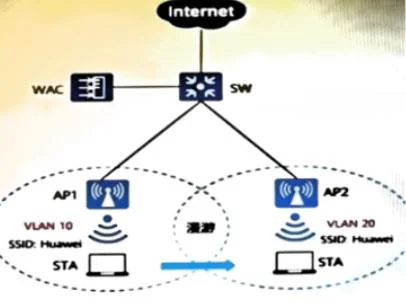
As shown in the figure, this is a WLAN network diagram of an enterprise. STA performs Layer 3 roaming in WAC, and the data forwarding mode is direct forwarding. At the same time, the user's home…
The correct answer is B. STA->AP2->WAC->Sw->Internet. Option B is correct because when a STA performs Layer 3 roaming and the home agent (HA) is configured on the WAC, the WAC intercepts traffic from the roamed STA regardless of the direct forwarding mode. After roaming to AP2, the STA retains its original home-network IP address…
Question
As shown in the figure, this is a WLAN network diagram of an enterprise. STA performs Layer 3 roaming in WAC, and the data forwarding mode is direct forwarding. At the same time, the user's home agent is configured on WAC. After STA roams, which of the following is the traffic forwarding path?
Exhibit
Options
- ASTA->AP2->SW>Internet
- BSTA->AP2->WAC->Sw->Internet
- CSTA->AP2->WAC->AP1->WAC->Sw->Internet
- DSTA->AP2->WAC->AP1->SW->Internet
How the community answered
(64 responses)- A8% (5)
- B77% (49)
- C3% (2)
- D13% (8)
Explanation
Option B is correct because when a STA performs Layer 3 roaming and the home agent (HA) is configured on the WAC, the WAC intercepts traffic from the roamed STA regardless of the direct forwarding mode. After roaming to AP2, the STA retains its original home-network IP address; AP2 tunnels that traffic to WAC (the home agent), and WAC then forwards it upstream to SW and out to the Internet - making the path STA→AP2→WAC→SW→Internet.
Why the distractors fail:
- A (STA→AP2→SW→Internet) ignores the home agent entirely. Direct forwarding without Layer 3 roaming would work this way, but once the STA's IP doesn't belong to AP2's subnet, the HA on WAC must intercept and re-route the traffic.
- C (…WAC→AP1→WAC→SW…) incorrectly loops traffic back through AP1 a second time, then back to WAC again. The home agent on WAC forwards directly to the upstream network - it never bounces back to the original AP.
- D (…WAC→AP1→SW…) also incorrectly hairpins traffic through AP1. Once WAC receives the traffic as home agent, it routes outward to SW, not back into the wireless infrastructure.
Memory tip: Think of WAC-as-home-agent like a postal forwarding service - your mail (traffic) arrives at the new address (AP2), gets forwarded to the post office that knows your original address (WAC/HA), and is then sent directly to its destination (Internet). The old address's mailbox (AP1) is never involved in the forwarding chain.
Topics
Community Discussion
No community discussion yet for this question.