
FCSS_SDW_AR-7.4 · Question #20
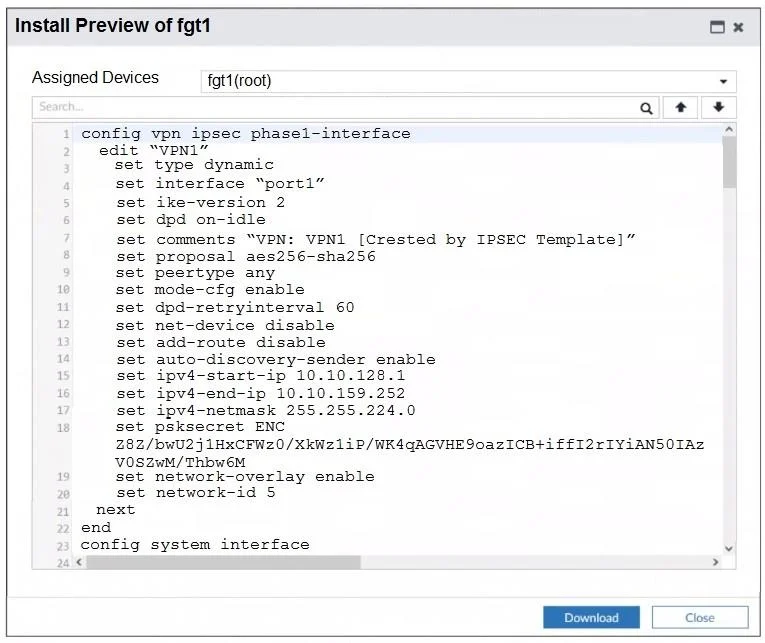
Refer to the exhibit. The administrator used the SD-WAN overlay template to prepare an IPsec tunnels configuration for a hub-and-spoke SD-WAN topology. The exhibit shows the FortiManager…
The correct answer is B. It is a hub device. It can send ADVPN shortcut offers. The phase1-interface shows set type dynamic, set peertype any, and set mode-cfg enable with an address pool (ipv4-start-ip, ipv4-end-ip, ipv4-netmask). Those are dial-up server settings-i.e., a hub handing out virtual IPs to spokes. It also has set auto- discovery-sender…
Question
Refer to the exhibit. The administrator used the SD-WAN overlay template to prepare an IPsec tunnels configuration for a hub-and-spoke SD-WAN topology. The exhibit shows the FortiManager installation preview for one FortiGate device. Based on the exhibit, which statement best describes the configuration applied to the FortiGate device?
Exhibit
Options
- AIt is a spoke device that establishes dynamic IPsec tunnels to the hub. The local subnet range is
- BIt is a hub device. It can send ADVPN shortcut offers.
- CIt is a hub device. It will automatically discover the spoke devices and add them to the SD-WAN
- DIt is a spoke device that establishes dynamic IPsec tunnels to the hub It can send ADVPN
How the community answered
(23 responses)- A4% (1)
- B74% (17)
- C9% (2)
- D13% (3)
Explanation
The phase1-interface shows set type dynamic, set peertype any, and set mode-cfg enable with an address pool (ipv4-start-ip, ipv4-end-ip, ipv4-netmask). Those are dial-up server settings-i.e., a hub handing out virtual IPs to spokes. It also has set auto- discovery-sender enable, allowing the hub to participate in ADVPN shortcut negotiation (sending offers).
Topics
Community Discussion
No community discussion yet for this question.