
FCSS_SDW_AR-7.4 · Question #33
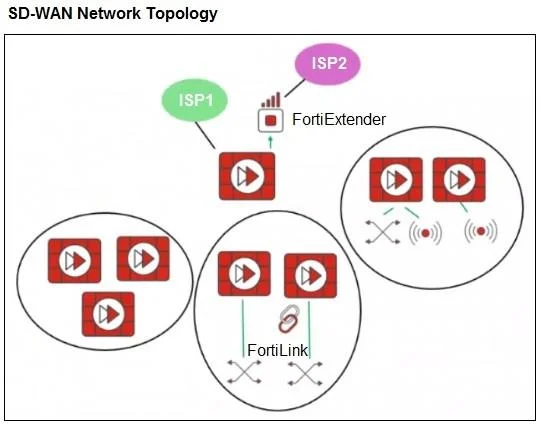
Refer to the exhibit. You want to configure SD-WAN on a network as shown in the exhibit. The network contains many FortiGate devices. Some are used as NGFW, and some are installed with extensions…
The correct answer is B. You can build an SD-WAN topology that includes all devices. The hubs must be devices without. You can include FortiGates with extensions (FortiSwitch/FortiAP/FortiExtender) as spokes in one SD-WAN topology, but the hubs should be clean FortiGate devices without extensions enabled. Extensions like FortiLink or FortiExtender add roles/services that can conflict with hub…
Question
Refer to the exhibit. You want to configure SD-WAN on a network as shown in the exhibit. The network contains many FortiGate devices. Some are used as NGFW, and some are installed with extensions such as FortiSwitch, FortiAP or FortiExtender. What should you consider when planning your deployment?
Exhibit
Options
- AYou can build an SD-WAN topology that includes all devices. The hubs can be FortiGate devices
- BYou can build an SD-WAN topology that includes all devices. The hubs must be devices without
- CYou must use FortiManager to manage your SD-WAN topology.
- DYou must build multiple SD-WAN topologies. Each topology must contain only one type of
How the community answered
(26 responses)- A12% (3)
- B77% (20)
- C8% (2)
- D4% (1)
Explanation
You can include FortiGates with extensions (FortiSwitch/FortiAP/FortiExtender) as spokes in one SD-WAN topology, but the hubs should be clean FortiGate devices without extensions enabled. Extensions like FortiLink or FortiExtender add roles/services that can conflict with hub duties (overlay termination, route distribution, scale/HA) and aren’t supported/recommended on hubs. No need to split into multiple topologies or require FortiManager just for that.
Topics
Community Discussion
No community discussion yet for this question.