
FCSS_CDS_AR-7.6 · Question #2
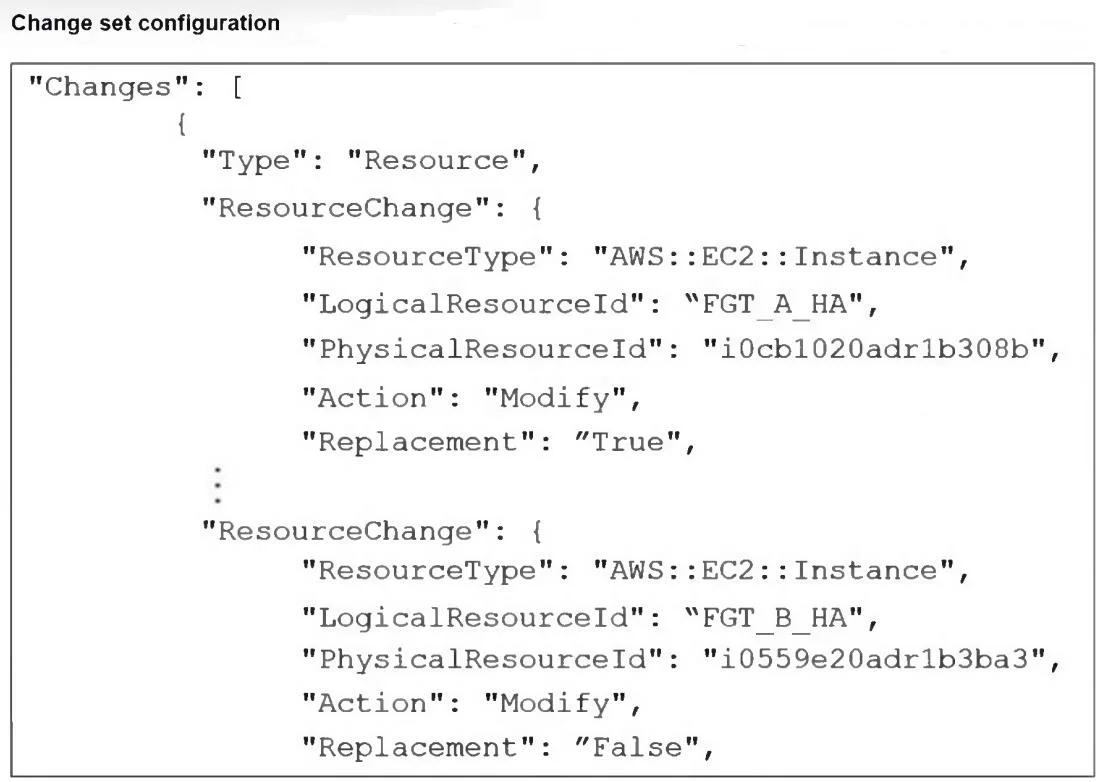
Refer to the exhibit. You are managing an active-passive FortiGate HA cluster in AWS that was deployed using CloudFormation. You have created a change set to examine the effects of some proposed…
The correct answer is B. Both FortiGate VMs will get a new PhysicalResourceId. When a CloudFormation change set shows Replacement: True for a resource, CloudFormation must tear down the existing resource and provision a brand-new one - and every newly created resource receives a new PhysicalResourceId. Since the change set indicates replacement for both…
Question
Refer to the exhibit. You are managing an active-passive FortiGate HA cluster in AWS that was deployed using CloudFormation. You have created a change set to examine the effects of some proposed changes to the current infrastructure. The exhibit shows some sections of the change set. What will happen if you apply these changes?
Exhibit
Options
- AThis deployment can be done without any traffic interruption.
- BBoth FortiGate VMs will get a new PhysicalResourceId.
- CThe updated FortiGate VMs will not have the latest configuration changes.
- DCloudFormation checks if you will surpass your account quota.
How the community answered
(50 responses)- A10% (5)
- B60% (30)
- C6% (3)
- D24% (12)
Explanation
When a CloudFormation change set shows Replacement: True for a resource, CloudFormation must tear down the existing resource and provision a brand-new one - and every newly created resource receives a new PhysicalResourceId. Since the change set indicates replacement for both FortiGate VM instances, both will be terminated and re-created, each receiving a new PhysicalResourceId (e.g., a new EC2 instance ID).
Why the distractors fail:
- A is wrong because replacing both instances in an active-passive cluster is highly disruptive - the active unit will go down during replacement, causing a traffic outage.
- C is a tempting trap: replaced instances do lose any out-of-band configuration changes (since they boot from the template), but the change set itself doesn't specifically reveal this outcome - it shows replacement, not a config gap.
- D is wrong because quota checking is a general CloudFormation behavior during stack creation/update, not a specific outcome tied to this particular change set.
Memory tip: Anytime you see Replacement: True in a CloudFormation change set, think "Old resource dies, new resource is born with a new ID." If you see it on multiple resources in an HA pair, that's a red flag for an outage, not a rolling update.
Topics
Community Discussion
No community discussion yet for this question.