
FCSS_CDS_AR-7.6 · Question #3
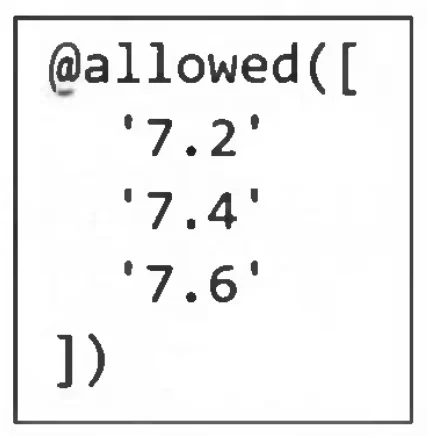
Refer to the exhibit. What is the purpose of this section of an Azure Bicep file?
The correct answer is A. To restrict which FortiOS versions are accepted for deployment. Option A is correct because Azure Bicep uses the allowedValues constraint (or @allowed decorator) on parameters to enforce a whitelist of acceptable inputs at deployment time - if a user specifies a FortiOS version not in the list, the deployment fails immediately with a…
Question
Refer to the exhibit. What is the purpose of this section of an Azure Bicep file?
Exhibit
Options
- ATo restrict which FortiOS versions are accepted for deployment
- BTo indicate the correct FortiOS upgrade path after deployment
- CTo add a comment with the permitted FortiOS versions that can be deployed
- DTo document the FortiOS versions in the resulting topology
How the community answered
(54 responses)- A74% (40)
- B15% (8)
- C4% (2)
- D7% (4)
Explanation
Option A is correct because Azure Bicep uses the allowedValues constraint (or @allowed decorator) on parameters to enforce a whitelist of acceptable inputs at deployment time - if a user specifies a FortiOS version not in the list, the deployment fails immediately with a validation error. This is an active enforcement mechanism, not passive documentation.
Why the distractors are wrong:
- B is wrong because Bicep files control deployment configuration, not post-deployment upgrade sequencing - upgrade paths are handled by operational runbooks or Fortinet documentation, not ARM/Bicep templates.
- C is wrong because Bicep comments use
//or/* */syntax; a structured list of version strings inallowedValuesis executable code that enforces policy, not a comment. - D is wrong because topology documentation lives in diagrams, wikis, or README files - Bicep files define infrastructure, not network topology records.
Memory tip: Think of allowedValues as a bouncer with a guest list - it doesn't just suggest who should enter, it physically blocks anyone not on the list at the door (deployment time). If it were just documentation or a comment, the bouncer would be asleep.
Topics
Community Discussion
No community discussion yet for this question.