
DP-300 · Question #408
Hotspot Question You have an Azure subscription. You need to deploy two virtual machines named VM1 and VM2 that will host Microsoft SQL Server instances. The solution must meet the following…
This question tests knowledge of Azure VM series optimized for SQL Server workloads, specifically which series provides the best I/O throughput-to-vCore ratio and which provides the best memory-to-vCore ratio.
Question
Exhibit
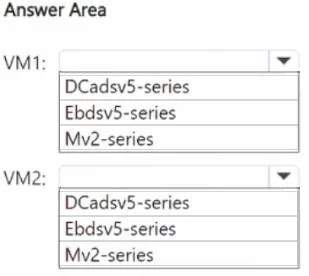
Answer Area
- VM1:DCadsv5-seriesEbdsv5-seriesMv2-series
- VM2:DCadsv5-seriesEbdsv5-seriesMv2-series
Explanation
This question tests knowledge of Azure VM series optimized for SQL Server workloads, specifically which series provides the best I/O throughput-to-vCore ratio and which provides the best memory-to-vCore ratio.
Approach. For VM1 requiring the highest I/O throughput-to-vCore ratio, the Lsv2-series (Storage Optimized) is the correct choice, as it provides local NVMe SSD storage with extremely high I/O throughput per vCore, making it ideal for I/O-intensive SQL Server workloads. For VM2 requiring the highest memory-to-vCore ratio, the M-series (Memory Optimized) is the correct choice, as it offers up to 3.8 TiB of RAM and provides the highest memory-to-vCore ratio of any Azure VM series, making it ideal for large in-memory SQL Server workloads like OLTP or in-memory OLAP. The Lsv2 series uses local NVMe directly attached storage for low latency and high throughput, while the M-series is purpose-built for memory-intensive enterprise workloads such as SAP HANA and large SQL Server databases.
Concept tested. Azure Virtual Machine series selection for SQL Server workloads - specifically understanding the distinction between Storage Optimized (Lsv2) for highest I/O throughput-to-vCore ratio and Memory Optimized (M-series) for highest memory-to-vCore ratio.
Reference. https://learn.microsoft.com/en-us/azure/virtual-machines/windows/sql/sql-server-on-azure-vm-iaas-what-is-overview and https://learn.microsoft.com/en-us/azure/virtual-machines/lsv2-series
Topics
Community Discussion
No community discussion yet for this question.