Case Study 5 - ADatum Corporation Overview ADatum Corporation is a financial services company that has a main office in New York City. Existing Environment Licensing Agreement ADatum has a Microsoft…
This hotspot question tests knowledge of Azure database migration and modernization options for ADatum's on-premises SQL Server workloads, specifically evaluating whether various statements about migration paths, features, and compatibility are true or false.
Submitted by jaden.t· Mar 6, 2026Plan and implement data platform resources
Question
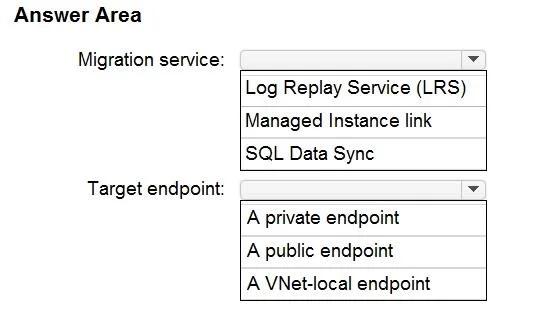
Case Study 5 - ADatum Corporation Overview ADatum Corporation is a financial services company that has a main office in New York City. Existing Environment Licensing Agreement ADatum has a Microsoft Volume Licensing agreement that includes Software Assurance. Network Infrastructure ADatum has an on-premises datacenter and an Azure subscription named Sub1. Sub1 contains a virtual network named Network1 in the East US Azure region. The datacenter is connected to Network1 by using a Site-to-Site (S2S) VPN. Identity Environment The on-premises network contains an Active Directory Domain Services (AD DS) forest. The forest contains a single domain named corp.adatum.com. The corp.adatum.com domain syncs with a Microsoft Entra tenant named adatum.com. Database Environment The datacenter contains the servers shown in the following table. DB1 and DB2 are used for transactional and analytical workloads by an application named App1. App1 runs on Microsoft Entra hybrid joined servers that run Windows Server 2022. App1 uses Kerberos authentication. DB3 stores compliance data used by two applications named App2 and App3. DB3 performance is monitored by using Extended Events sessions, with the event_file target set to a file share on a local disk of SVR3. Resource allocation for DB3 is managed by using Resource Governor. Requirements Planned Changes ADatum plans to implement the following changes: - Deploy an Azure SQL managed instance named Instance1 to Network1. - Migrate DB1 and DB2 to Instance1. - Migrate DB3 to Azure SQL Database. - Following the migration of DB1 and DB2, hand over database development to remote developers who use Microsoft Entra joined Windows 11 devices. - Following the migration of DB3, configure the database to be part of an auto-failover group. Availability Requirements ADatum identifies the following post-migration availability requirements: - For DB1 and DB2, offload analytical workloads to a read-only database replica in the same Azure region. - Ensure that if a regional disaster occurs, DB1 and DB2 can be recovered from backups. - After the migration, App1 must maintain access to DB1 and DB2. - For DB3, manage potential performance issues caused by resource demand changes by App2 and App3. - Ensure that DB3 will still be accessible following a planned failover. - Ensure that DB3 can be restored if the logical server is deleted. - Minimize downtime during the migration of DB1 and DB2. Security Requirements ADatum identifies the following security requirements for after the migration: - Ensure that only designated developers who use Microsoft Entra joined Windows 11 devices can access DB1 and DB2 remotely. - Ensure that all changes to DB3, including ones within individual transactions, are audited and recorded. Management Requirements ADatum identifies the following post-migration management requirements: - Continue using Extended Events to monitor DB3. - In Azure SQL Database, automate the management of DB3 by using elastic jobs that have database-scoped credentials. Business Requirements ADatum identifies the following business requirements: - Minimize costs whenever possible, without affecting other requirements. - Minimize administrative effort. Hotspot Question You need to recommend which service and target endpoint to use when migrating the databases from SVR1 to Instance1. The solution must meet the availability requirements. What should you recommend? To answer, select the appropriate options in the answer area. NOTE: Each correct selection is worth one point. Answer:
Exhibit
Answer Area
Migration service:
Log Replay Service (LRS)Managed Instance linkSQL Data Sync
Target endpoint:
A private endpointA public endpointA VNet-local endpoint
Explanation
This hotspot question tests knowledge of Azure database migration and modernization options for ADatum's on-premises SQL Server workloads, specifically evaluating whether various statements about migration paths, features, and compatibility are true or false.
Approach. For ADatum's scenario, the correct approach involves understanding which Azure database services best map to their existing workloads: DB1 and DB2 (transactional/analytical workloads with Kerberos authentication on hybrid-joined servers) would map to Azure SQL Managed Instance (MI) since it supports Kerberos authentication, hybrid-joined servers, and near-100% SQL Server compatibility. DB3 (compliance data monitored via Extended Events sessions) also benefits from Azure SQL Managed Instance because it natively supports Extended Events, unlike Azure SQL Database which has limited Extended Events support. Software Assurance benefits like Azure Hybrid Benefit should be leveraged to reduce licensing costs given ADatum's Volume Licensing agreement.
Concept tested. Azure SQL migration options (Azure SQL Managed Instance vs Azure SQL Database vs SQL Server on Azure VMs), feature compatibility including Kerberos authentication support, Extended Events sessions support, hybrid-joined server connectivity, and Azure Hybrid Benefit licensing for organizations with Software Assurance agreements