
DP-300 · Question #298
Hotspot Question You need to deploy an Azure SQL Database elastic pool by using a Bicep template. How should you complete the template? To answer, select the appropriate options in the answer area…
The correct answer is resource symbolicname 'Microsoft.Sql/: instancePools; Property for integer value: minCapacity. This hotspot question tests your ability to construct a valid Bicep template for deploying an Azure SQL Database elastic pool, requiring correct resource type, API version, SKU properties, and elastic pool-specific properties.
Question
Exhibit
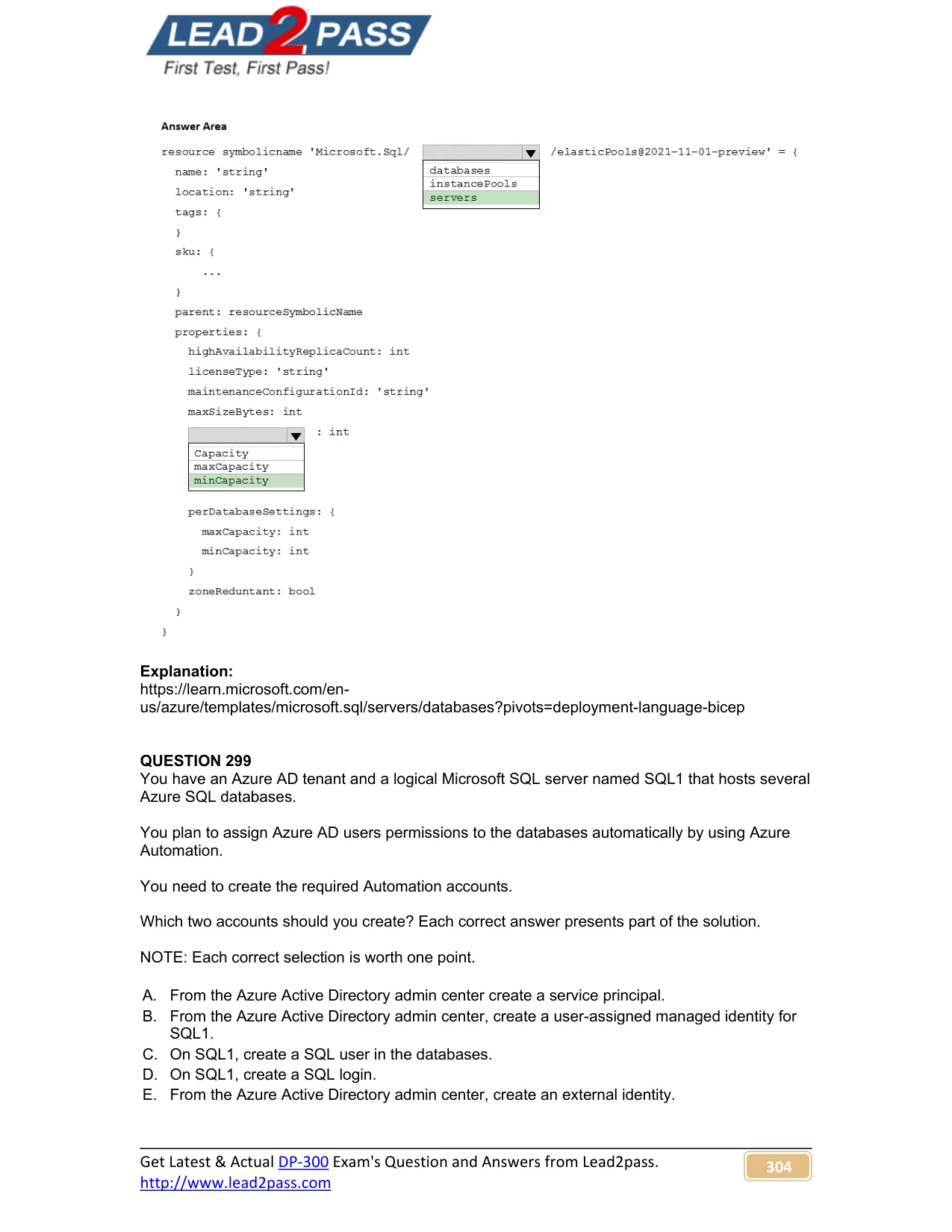
Answer Area
- resource symbolicname 'Microsoft.Sql/instancePoolsdatabasesinstancePoolsservers
- Property for integer valueminCapacityCapacitymaxCapacityminCapacity
Explanation
This hotspot question tests your ability to construct a valid Bicep template for deploying an Azure SQL Database elastic pool, requiring correct resource type, API version, SKU properties, and elastic pool-specific properties.
Approach. To deploy an Azure SQL Database elastic pool in Bicep, the resource type must be 'Microsoft.Sql/servers/elasticPools' since elastic pools are child resources of a SQL Server. The SKU block requires a 'name' (e.g., 'StandardPool' or 'GP_Gen5_2') and 'tier' (e.g., 'Standard' or 'GeneralPurpose') to define the service tier. The 'properties' block must include 'maxSizeBytes' to define the pool storage limit, and the 'perDatabaseSettings' object must be nested within 'properties' to specify 'minCapacity' and 'maxCapacity' (DTUs or vCores) per database. The parent SQL server is referenced using the 'parent' keyword in Bicep or by embedding the server name in the resource name using '::' or '/' notation, ensuring proper resource hierarchy and dependency management.
Concept tested. Bicep template syntax and structure for deploying Azure SQL Database elastic pools, including correct resource type hierarchy (Microsoft.Sql/servers/elasticPools), SKU configuration, and elastic pool properties such as perDatabaseSettings for min/max capacity and maxSizeBytes for storage.
Topics
Community Discussion
No community discussion yet for this question.